


El control organizacional desde una mirada flexible y adaptable Organizational Control from a Flexible and Adaptable Perspective
Main Article Content
-
Yaliangélica Briceño Romero
- Investigation
- Conceptualization
- Formal Analysis
- Project Administration
- Visualization
- Writing – Review & Editing
Competing InterestsNone
-
Nadeska Gallardo Lichaá
- Data Curation
- Validation
- Writing – Review & Editing
Competing InterestsNone
 https://orcid.org/0009-0001-1214-3880
How to Cite
Recibido: 3 de diciembre de 2025; Aceptado: 13 de abril de 2026; : 26 de mayo de 2026
Resumen
Problemática: en entornos organizacionales caracterizados por volatilidad, incertidumbre y transformación digital, los modelos tradicionales de control resultan insuficientes para gestionar la complejidad y promover la adaptabilidad. Objetivo: analizar la evolución del control organizacional desde una perspectiva flexible y adaptable, integrando los aportes del pensamiento complejo y la transdisciplinariedad, e identificando tendencias teóricas y empíricas en la literatura reciente. Metodología: se realizó una revisión sistemática cualitativa bajo el protocolo prisma . La búsqueda en bases de datos internacionales identificó 212 registros (2015-2025); tras depuración y evaluación de elegibilidad, se seleccionaron 30 estudios para el análisis. Resultados: se identifican tres tendencias principales: predominio de enfoques cualitativos centrados en mecanismos relacionales del control; integración entre control formal y confianza organizacional; y articulación con aprendizaje adaptativo y agilidad organizacional. Conclusión: el control organizacional contemporáneo se configura como un proceso relacional, complejo y adaptativo que integra estructuras formales, confianza y aprendizaje, orientado a equilibrar estructura y autonomía en contextos inciertos. Contribución/originalidad: el estudio aporta una visión original e integradora del control organizacional al incorporar el pensamiento complejo y la transdisciplinariedad como base para reinterpretar el control desde una lógica flexible, dinámica y adaptativa.
Palabras clave
descentralizacion, isdel, desarrollo local, planificación, municipios, descentralizacion, isdel, desarrollo local, planificación, municipios, economía de la salud, política de la salud, servicio de salud, sistemas de salud, reforma de la atención de salud. Clasificación JEL: P46, I1, A12, economía de la salud, política de la salud, servicio de salud, sistemas de salud, reforma de la atención de salud. Clasificación JEL: P46, I1, A12, mercado de trabajo, informalidad, economía regional, política de empleo. Códigos JEL: J46, O17, C25, mercado de trabajo, informalidad, economía regional, política de empleo. Códigos JEL: J46, O17, C25, diversidad cognitiva, condiciones organizacionales, análisis factorial confirmatorio, cultura organizacional inclusiva, diversidad cognitiva, condiciones organizacionales, análisis factorial confirmatorio, cultura organizacional inclusiva, control interno, modelo coso, gobernanza, empleo público, meritocracia, control interno, modelo coso, gobernanza, empleo público, meritocracia, desarrollo local, desempleo, espacio público, gestión de los asuntos públicos, trabajo informal, desarrollo local, desempleo, espacio público, gestión de los asuntos públicos, trabajo informal, infraestructura portuaria, proyección portuaria, transporte multimodal, tráfico marítimo, infraestructura portuaria, proyección portuaria, transporte multimodal, tráfico marítimo, Sistema General de Regalías, monitoreo del ciclo de vida del producto, seguimiento ex post, gestión de proyectos públicos, eficiencia del gasto público, Sistema General de Regalías, monitoreo del ciclo de vida del producto, seguimiento ex post, gestión de proyectos públicos, eficiencia del gasto público, lean manufacturing, industria maquiladora, liderazgo transformacional, enfoque al cliente, lean manufacturing, industria maquiladora, liderazgo transformacional, enfoque al cliente, índices de desempeño, mipg, entidades distritales, sector público, índices de desempeño, mipg, entidades distritales, sector público, control organizacional, pensamiento complejo, confianza organizacional, aprendizaje organizacional, control organizacional flexible, control organizacional, pensamiento complejo, confianza organizacional, aprendizaje organizacional, control organizacional flexible.Abstract
Problem Statement: In volatile and digitally transformed environments, traditional control models are insufficient to effectively manage complexity and foster adaptability. Objective: To analyze the evolution of organizational control through a flexible, adaptive lens, integrating complexity theory and transdisciplinarity to identify recent theoretical and empirical trends. Methodology: A qualitative systematic literature review was conducted using the prisma protocol. From 212 records identified in international academic databases (2015–2025), 30 studies met the strict eligibility criteria for final analysis. Results: Three primary trends emerged: a predominance of qualitative approaches focusing on relational control mechanisms; the integration of formal control with organizational trust; and the alignment of control with adaptive learning and agility. Conclusion: Contemporary organizational control operates as a relational, complex, and adaptive process that integrates formal structures, trust, and learning to balance stability and autonomy in uncertain environments. Contribution/Originality: This study provides an integrative perspective by applying complexity theory and transdisciplinarity to reinterpret organizational control through a flexible, dynamic, and adaptive logic.
Keywords
Decentralization, isdel, Local Development, Planning, Municipalities, Decentralization, isdel, Local Development, Planning, Municipalities, Health economics, Health policy, Health services, Health Systems, Health Care Reform. JEL Classification: P46, I1, A12, Health economics, Health policy, Health services, Health Systems, Health Care Reform. JEL Classification: P46, I1, A12, Labor mobility, employment policy, regional economy, labor market. JEL Codes: J46, O17, C25, Labor mobility, employment policy, regional economy, labor market. JEL Codes: J46, O17, C25, Cognitive diversity, Organizational conditions, Confirmatory factor analysis, Inclusive organizational culture, Cognitive diversity, Organizational conditions, Confirmatory factor analysis, Inclusive organizational culture, Internal Control, COSO Model, Governance, Public Employment, Meritocracy, Internal Control, COSO Model, Governance, Public Employment, Meritocracy, local development, unemployment, public space, management of public affairs, informal employment, local development, unemployment, public space, management of public affairs, informal employment, port infrastructure, port projection, multimodal transport, maritime traffic, port infrastructure, port projection, multimodal transport, maritime traffic, General System of Royalties ( sgr ), Product Life‑Cycle Monitoring, Ex post evaluation, Public project management, Public expenditure efficiency, General System of Royalties ( sgr ), Product Life‑Cycle Monitoring, Ex post evaluation, Public project management, Public expenditure efficiency, lean manufacturing, maquiladora industry, transformational leadership, customer focus, lean manufacturing, maquiladora industry, transformational leadership, customer focus, performance indices, mipg, public sector, public management, performance indices, mipg, public sector, public management, organizational control, complex thinking, organizational trust, organizational learning, flexible organizational control, organizational control, complex thinking, organizational trust, organizational learning, flexible organizational control.Introducción
En el contexto actual, caracterizado por entornos vuca (volatilidad, incertidumbre, complejidad y ambigüedad), los modelos tradicionales de control organizacional enfrentan crecientes limitaciones para sostener el desempeño y la adaptabilidad. Este escenario ha consolidado a vuca como un marco de referencia clave para comprender las condiciones contemporáneas de gestión, en las cuales la estabilidad y la previsibilidad ya no constituyen supuestos garantizados. En consecuencia, las organizaciones se ven obligadas a replantear sus enfoques de control, transitando hacia modelos más flexibles, dinámicos y orientados a la adaptación. Históricamente, el control organizacional se ha sustentado en enfoques racionales, jerárquicos y normativos, desarrollados y sistematizados por autores como Ouchi (1979) y Anthony y Govindarajan (2014) . Estas perspectivas parten de la premisa de que el comportamiento organizacional puede ser anticipado y regulado mediante normas, estructuras formales y sistemas de incentivos. No obstante, en entornos caracterizados por la innovación y la colaboración, estos enfoques lineales resultan insuficientes, lo que ha impulsado la necesidad de sistemas de control más flexibles, capaces de integrar la autonomía, la coordinación y la adaptación organizacional. En esta línea, diversas investigaciones han cuestionado la rigidez del control y propuesto enfoques más flexibles, adaptativos y relacionales. Simons (1995) introduce el concepto de levers of control como mecanismos para el aprendizaje estratégico, mientras Merchant y Van der Stede (2017) destacan la necesidad de equilibrar medición y juicio. Por su parte, Bijlsma-Frankema y Costa (2019) plantean que la confianza y el control son dimensiones complementarias que fortalecen la coordinación y la innovación. Estudios recientes confirman que los sistemas basados en la confianza favorecen el compromiso y la adaptabilidad, incluso en contextos tradicionalmente jerárquicos ( Flinkman et al., 2025 ; Johansson-Berg y Siverbo, 2025 ). Asimismo, la incorporación de metodologías ágiles ha contribuido a redefinir la función del control organizacional. Estos enfoques se basan en ciclos continuos de retroalimentación y visibilidad compartida, promoviendo la autonomía de los equipos, sin perder la alineación estratégica ( Dobrowolski et al., 2021 ; Koudriachov et al., 2025 ). En este sentido, el control se orienta más hacia la facilitación de la adaptación que hacia la supervisión rígida. Comprender el control organizacional en este contexto implica reconocer su carácter complejo. Desde el pensamiento complejo, Morin (2005) plantea que el control no debe entenderse como un mecanismo de dominación, sino como un proceso que articula la autonomía y la dependencia dentro de sistemas organizacionales dinámicos. En esta perspectiva, el control se configura como un proceso de regulación adaptativa que integra diversidad, incertidumbre y cambio. De manera complementaria, la transdisciplinariedad de Nicolescu (2014) sugiere que el control organizacional debe abordarse desde múltiples niveles de realidad, integrando dimensiones técnicas, humanas y éticas. En este sentido, los sistemas de control trascienden su función instrumental para convertirse en espacios donde se articulan prácticas, valores y significados compartidos. La literatura sobre liderazgo complejo refuerza esta visión al plantear que el liderazgo y el control emergen de las interacciones organizacionales, más que de la imposición jerárquica ( Jiang et al., 202 3; Uhl-Bien et al., 2007 ). De forma similar, la teoría de las capacidades dinámicas ( Teece, 2018 ) señala que la sostenibilidad organizacional depende de la capacidad de reconfiguración continua más que del control del entorno. Esta transformación también ha implicado un giro hacia la dimensión humana del control. La noción de seguridad psicológica evidencia que los equipos que pueden expresar errores y desacuerdos desarrollan mayores niveles de aprendizaje y resiliencia ( Edmondson y Bransby, 2023 ; Edmondson y Lei, 2014 ). En consecuencia, el control deja de centrarse en la corrección para orientarse al aprendizaje organizacional. No obstante, persisten tensiones entre estructura y flexibilidad, rendición de cuentas y creatividad, así como entre control formal y dinámicas informales. En este contexto, el problema central de investigación radica en comprender cómo se configura un control organizacional flexible y adaptable que equilibre la exigencia de resultados con la capacidad de aprendizaje y reconfiguración en entornos cambiantes ( Röttgen et al., 2024 ). En consecuencia, el presente artículo tiene como objetivo analizar c ríticamente la literatura académica publicada entre 2015 y 2025 sobre control organizacional flexible y adaptable, desde la convergencia del pensamiento complejo y la transdisciplinariedad. El estudio asume que el control organizacional es un fenómeno multidimensional que integra estructuras formales, mecanismos relacionales basados en la confianza, procesos de aprendizaje adaptativo y enfoques complejos de regulación organizacional. A partir de una revisión sistemática, se identifican patrones, tendencias y vacíos en la literatura, y se propone una interpretación integradora del control organizacional como un sistema dinámico capaz de articular estructura, autonomía y aprendizaje en contextos de complejidad.
Metodología
El presente estudio se desarrolló mediante un enfoque cualitativo de revisión sistemática, orientado a integrar, analizar y reinterpretar críticamente la producción científica relacionada con el control organizacional desde una perspectiva flexible y adaptable. La revisión cubrió el periodo comprendido entre 2015 y 2025 y se estructuró conforme a las recomendaciones del protocolo prisma (Preferred Reporting Items for Systematic Reviews and Meta-Analyses), adaptado a revisiones cualitativas ( Moher et al., 2009 ; Page et al., 2021 ). Desde una postura epistemológica, el proceso se concibió como un ejercicio interpretativo y reflexivo sustentado en los postulados del pensamiento complejo ( Morin, 2005 ) y la transdisciplinariedad ( Nicolescu, 2014 ), entendiendo el control organizacional como un fenómeno emergente que articula dimensiones estructurales, culturales, simbólicas y humanas. La búsqueda de información se realizó en bases de datos académicas de reconocida relevancia en ciencias de la gestión y las organizaciones, específicamente Scopus, Web of Science, ScienceDirect, ebsco host, Google Scholar y Redalyc, complementadas con libros académicos y capítulos de obras colectivas. Se incluyeron publicaciones revisadas por pares disponibles en inglés y español, priorizando su actualidad, rigor metodológico y pertinencia temática. La estrategia de búsqueda se diseñó mediante la combinación de términos clave utilizando operadores booleanos, con el propósito de abarcar las principales dimensiones conceptuales del objeto de estudio. La ecuación principal empleada fue: (“organizational control” OR “management control systems” OR “trust-based control” OR “adaptive control”) AND (“flexibility” OR “agility” OR “complexity” OR “learning organization” OR “transdisciplinarity” OR “complex thinking”). La trazabilidad del proceso de búsqueda y selección fue documentada conforme a las directrices prisma y registrada de manera sistemática. Los criterios de inclusión consideraron publicaciones científicas, como artículos, libros, capítulos o revisiones, editadas entre 2015 y 2025, con enfoques teóricos o empíricos vinculados al control organizacional, la gestión flexible, la confianza y el aprendizaje organizacional, disponibles en texto completo y con calidad académica verificable mediante indexación o revisión por pares. Se excluyeron documentos sin evaluación académica, ensayos o notas técnicas sin aportes conceptuales relevantes, estudios redundantes o duplicados, así como publicaciones anteriores a 2015, con excepción de obras teóricas fundacionales necesarias para el marco conceptual ( Morin, 2005 ; Nicolescu, 2002 ; Ouchi, 1979 ; Simons, 1995 ). Con el fin de asegurar la calidad metodológica de los estudios incluidos, se realizó una evaluación cualitativa basada en criterios de rigor académico utilizados en revisiones sistemáticas de literatura. Estos criterios consideraron: (i) claridad en la formulación del problema de investigación, (ii) coherencia entre objetivos, diseño metodológico y resultados, (iii) consistencia conceptual en el abordaje del control organizacional, y (iv) pertinencia metodológica del estudio en relación con el fenómeno analizado. La aplicación de estos criterios permitió seleccionar estudios con suficiente calidad científica para sustentar el análisis temático y la interpretación conceptual desarrollada en esta revisión. Como resultado del proceso de búsqueda inicial se identificaron 212 registros; posteriormente, se eliminaron 34 duplicados mediante el uso de un gestor bibliográfico, y se realizó un cribado preliminar de títulos, resúmenes y palabras clave, del cual se retuvieron 178 documentos para evaluación de elegibilidad. Tras la lectura completa y la aplicación de criterios de calidad metodológica y pertinencia temática, se seleccionaron 30 estudios para el análisis cualitativo final, de acuerdo con el flujo establecido por el diagrama prisma . El análisis de la información se desarrolló mediante un proceso de codificación temática inductiva, apoyado en matrices de análisis que permitieron organizar, clasificar y contrastar los contenidos de las fuentes seleccionadas. Este procedimiento combinó la sistematicidad propia del enfoque prisma con la reflexividad del pensamiento complejo, favoreciendo la emergencia de categorías interpretativas a partir del diálogo entre la literatura revisada y los marcos teóricos de referencia. Las categorías centrales identificadas fueron: la evolución del control organizacional desde modelos mecanicistas hacia enfoques adaptativos; la dimensión relacional del control y su articulación con la confianza; la vinculación entre control, aprendizaje organizacional e innovación; y la reinterpretación del control como un proceso transdisciplinario, dinámico y ético en contextos de alta incertidumbre. La gestión de referencias, la detección de duplicados, la organización de documentos y la codificación inicial de conceptos se realizó mediante el software Mendeley, que funcionó como repositorio central y herramienta de apoyo al proceso analítico. La revisión estuvo guiada por subpreguntas orientadas a comprender cómo ha evolucionado el control organizacional en entornos complejos, qué enfoques integran control formal y confianza, qué relación existe entre control y aprendizaje organizacional adaptativo, qué vacíos persisten en la literatura, especialmente en contextos latinoamericanos, y de qué manera el control se reconfigura desde una perspectiva compleja y transdisciplinaria. La validez del estudio se garantizó mediante la triangulación teórica de distintas corrientes de pensamiento, la rastreabilidad del proceso metodológico y una postura de reflexividad analítica que reconoce la interacción entre el investigador, los textos y los contextos de producción científica. La revisión se basó exclusivamente en fuentes secundarias, de acceso público o institucional, sin manipulación de datos primarios ni intervención con sujetos de estudio, respetando los principios de integridad académica y las normas de citación apa 7.ª edición, con inclusión de doi cuando estuvieron disponibles.
Resultados
El proceso de revisión sistemática permitió identificar treinta estudios que abordan el control organizacional desde enfoques flexibles, adaptativos o transdisciplinarios. Estos documentos fueron seleccionados conforme al protocolo prisma 2020 ( Page et al., 2021 ), garantizando la transparencia y trazabilidad del proceso. La búsqueda inicial arrojó 212 registros en las bases de datos Scopus, Web of Science, EBSCOhost, ScienceDirect, Google Scholar y Redalyc. Tras la eliminación de 34 duplicados mediante el gestor bibliográfico Mendeley, se evaluaron 178 registros durante la fase de cribado. De ellos, 100 fueron excluidos por no ajustarse a los criterios de inclusión (falta de revisión por pares, escasa relevancia temática o ausencia de texto completo). Los 78 artículos restantes pasaron a la fase de elegibilidad, donde se examinaron en texto completo; finalmente, 30 estudios cumplieron con los estándares de calidad y pertinencia definidos para el análisis cualitativo, tal como se muestra en la figura 1
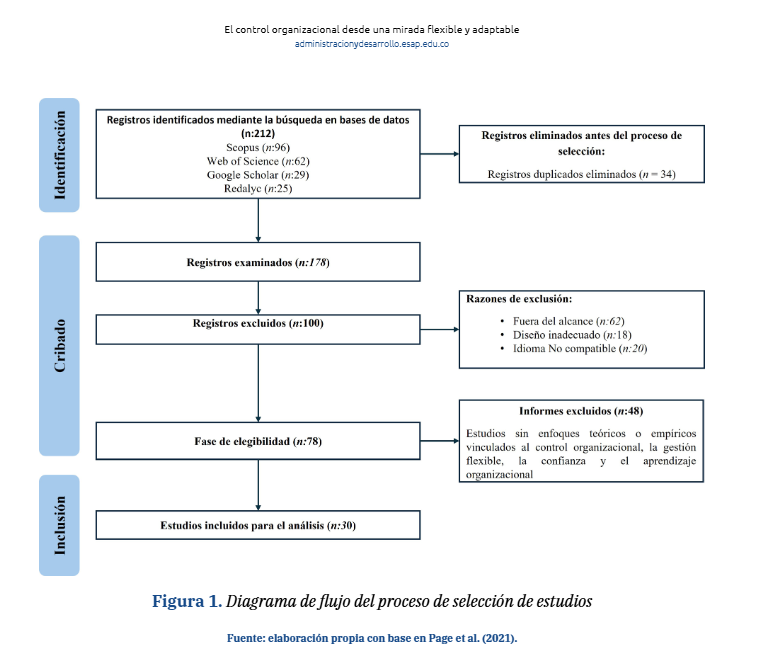
Figura 1:
: De los 30 estudios finales, el 65 % aborda organizaciones privadas, principalmente empresas tecnológicas y de serv icios; el 25 % analiza casos en el sector público, y el 10 % corresponde a instituciones académicas o modelos híbridos. En cuanto a distribución temporal, entre 2015 y 2018 predominaron los trabajos teóricos que reinterpretan los modelos de control clásicos ( Anthony y Govindarajan, 2014 ; Simons, 1995 ), mientras que entre 2019 y 2025 se observa un crecimiento de investigaciones empíricas enfocadas en entornos ágiles, colaborativos y basados en la confianza ( Bijlsma-Frankema y Costa, 2019 ; Dobrowolski et al., 202 1 ; Searle et al., 2025 ). El análisis revela además un crecimiento sostenido del interés académico: el número de publicaciones sobre control organizacional flexible se triplicó en la última década, impulsado por los desafíos de la digitalización y los entornos vuca ( Bennett y Lemoine, 2014 ). La integración de perspectivas provenientes de la teoría de la complejidad ( Stacey, 2016 ; Uhl-Bien et al., 2007 ) y de la gestión basada en la confianza ( Flinkman et al., 2025 ; Johansson- Berg y Siverbo, 2025 ) consolida un campo de investigación emergente que redefine las funciones clásicas del control dentro de las organizaciones contemporáneas.
Descripción de la revisión sistemática de literatura
El conjunto final de documentos refleja un panorama en transformación respecto a la forma como las organizaciones comprenden y ejercen el control, que lejos de limitarse a una descripción cuantitativa, constituye una cartografía intelectual de las tendencias, tensiones y transiciones epistemológicas que reconfiguran el campo de la gestión contemporánea. El 65 % de las investigaciones se desarrolla en contextos organizacionales privados, especialmente en empresas tecnológicas, manufactureras y de servicios, donde la presión por innovar y responder a entornos inestables ha impulsado la adopción de sistemas de control ágiles y adaptativos ( Koudriachov et al., 2025 ). En este ámbito, el control se resignifica como un mecanismo de coordinación dinámica, más cercano a un proceso de sense-making ( Weick, 1995 ) que a una estructura de supervisión formal. Las compañías tecnológicas y los sectores de alta volatilidad, como las start-ups digitales, tienden a priorizar mecanismos de control relacionales basados en la confianza, donde la autonomía y la autoevaluación se convierten en herramientas para sostener la coherencia organizacional ( Bijlsma-Frankema y Costa, 2019 ; Flinkman et al., 2025 ). El 25 % de los estudios procede del sector público, un espacio históricamente asociado a sistemas de control normativo y jerárquico. Sin embargo, la evidencia muestra una tendencia creciente hacia modelos híbridos de gestión, que integran marcos de confianza y flexibilidad institucional ( Svare et al., 2023 ). Estas experiencias, particularmente en países escandinavos y del norte de Europa, revelan que el control basado en la confianza no solo mejora la eficiencia administrativa, sino que potencia la innovación impulsada por los empleados, al reducir la distancia entre gestión y operación. En este sentido, el control deja de ser un dispositivo de cumplimiento para convertirse en una herramienta de corresponsabilidad colectiva, coherente con la noción moriniana de auto-eco-organización, en la que el sistema se regula a partir de sus propias interacciones ( Morin, 2005 ). El 10 % restante corresponde a instituciones académicas y modelos híbridos, donde el control organizacional se analiza como una práctica sociocognitiva y simbólica, de allí que las investigaciones enfaticen que el control no solo gestiona recursos, sino también significados, legitimidades y relaciones de poder ( Merchant y Van der Stede, 2017 ). Desde la transdisciplinariedad de Nicolescu (2014) , estos estudios asumen que los sistemas de control son espacios de traducción entre distintos niveles de realidad: lo técnico, lo humano y lo institucional. La figura 2
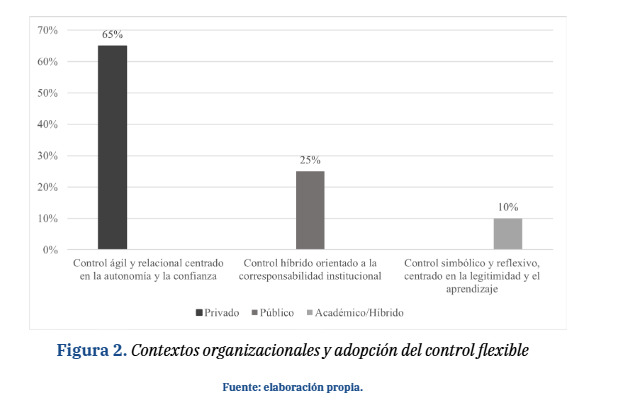
Figura 2:
evidencia que la adopción del control organizacional flexible se distribuye de manera desigual entre los contextos institucionales. El sector privado (65 %) se posiciona como el principal laboratorio de experimentación en mecanismos adaptativos, debido a su exposición directa a la incertidumbre del mercado y a los entornos vuca . En este ámbito, el control deja de ser un dispositivo de supervisión y pasa a concebirse como un proceso emergente de coordinación relacional, sustentado en la confianza y en la comunicación transversal ( Bijlsma-Frankema y Costa, 2019 ). El sector público (25 %), aunque históricamente anclado en estructuras jerárquicas, muestra un cambio progresivo hacia modelos híbridos, donde la corresponsabilidad y la autonomía se reconocen como principios complementarios. Este giro refleja una reinterpretación del control en clave ético-política, en la que la rendición de cuentas se equilibra con la confianza institucional ( Svare et al., 2023 ). Por su parte, el sector académico e híbrido (10 %) asume el control desde una dimensión simbólica y reflexiva, reconociendo que toda forma de regulación implica también la producción de sentido. Esta aproximación coincide con la noción moriniana de auto-eco-organización, donde los sistemas se mantienen vivos mediante procesos de autorregulación y retroalimentación ( Morin, 2005 ). La figura sugiere que los contextos organizacionales están transitando hacia una visión del control más ontológica que instrumental, en la que la flexibilidad no implica pérdida de estructura, sino reconfiguración de las relaciones entre orden y autonomía. Este hallazgo abre paso a la posibilidad de reflexionar sobre el modo en que la cultura organizacional y la ética institucional median la adopción del control adaptable. En términos geográficos, la revisión evidencia una concentración de estudios en Europa occidental (37 %), lo que coincide con el liderazgo académico de países como Suecia, Noruega, Finlandia, los Países Bajos y el Reino Unido, donde los enfoques basados en la confianza y el liderazgo adaptativo han ganado notable tracción ( Jiang et al., 2023 ; Uhl-Bien et al., 2007 ). América del Norte (26 %) continúa siendo un referente en la teoría del control formal y los sistemas de medición del desempeño ( Simons, 1995 ; Teece, 2018 ), aunque con un giro hacia perspectivas más contextuales y conductuales. En Asia-Pacífico (19 %), el énfasis se orienta hacia la integración entre control y tecnología, destacando estudios sobre digitalización, inteligencia artificial y aprendizaje organizacional. Por su parte, América Latina (12 %) aporta reflexiones emergentes que vinculan el control con la ética, la cultura y la sostenibilidad; y aunque los contextos africanos (6 %) aún presentan baja representación, comienzan a emerger investigaciones que relacionan el control con la gestión comunitaria y la gobernanza participativa. La figura 3
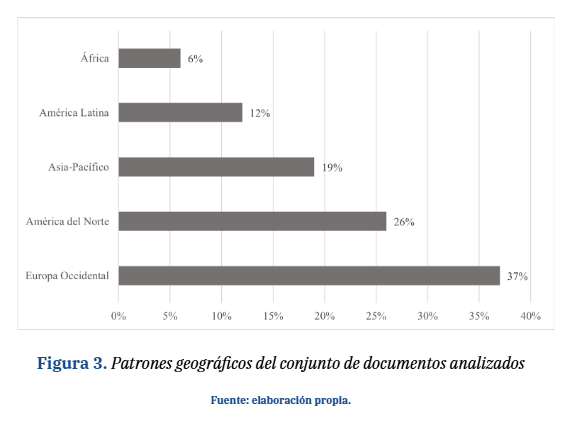
Figura 3:
muestra una clara asimetría geográfica en la producción académica, y se observa que en Europa occidental (37 %) se concentra la mayoría de los estudios, consolidándose como el núcleo epistemológico del control basado en la confianza, la cooperación y el liderazgo complejo. Esta hegemonía responde a un con texto sociocultural donde la institucionalidad favorece la autonomía responsable y la co-crea ción, principios que dialogan con la visión de Nicolescu (2014) sobre la transdisciplinariedad como práctica de encuentro entre diferentes niveles de realidad. En América del Norte (26 %), el control organizacional se estudia desde perspectivas más pragmáticas, vinculadas a la eficiencia y la innovación tecnológica. Sin embargo, los trabajos recientes comienzan a incorporar una visión conductual y adaptativa, señalando un desplazamiento del paradigma clásico hacia enfoques más complejos. El área Asia-Pacífico (19 %) aporta una perspectiva emergente donde el control se integra con la digitalización y los ecosistemas tecnológicos, reflejando la interacción entre disciplina cultural y flexibilidad estructural. En contraste, América Latina (12 %) y África (6 %) representan territorios de oportunidad teórica: sus contribuciones, aun que minoritarias, apuntan a un control con anclaje ético, comunitario y contextual, más cercano a los principios de sostenibilidad y justicia organizacional. Este mapa geográfico no solo expone la distribución del conocimiento, sino que revela una diversidad epistemológica: el control organizacional ya no pertenece a un solo paradigma occidental, sino que comienza a globalizarse en clave de pluralidad y adaptación contextual. Esta perspectiva de diversidad respalda la idea de Morin (2011) de que el conocimiento científico debe reconciliar la unidad del método con la diversidad de lo real. En suma, la composición de la revisión muestra que el campo del control organizacional se encuentra en una fase de madurez teórica y apertura epistemológica. Su estudio actual exige comprender las organizaciones como sistemas autoorganizados en los que la regulación y la libertad coexisten. Este cambio paradigmático anticipa una evolución hacia modelos de gestión que, en lugar de sofocar la complejidad, aprenden a convivir con ella. La figura 4
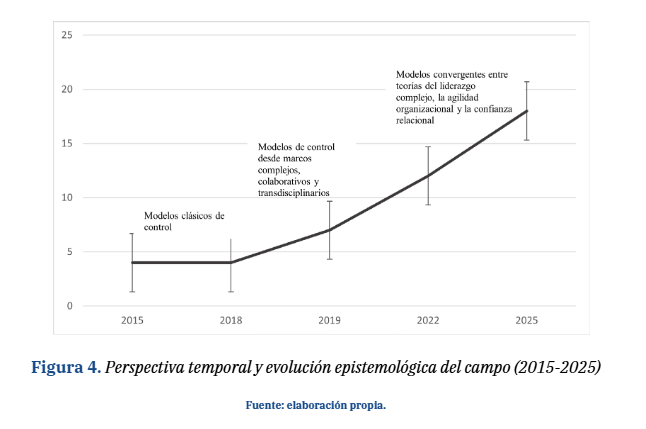
Figura 4:
sintetiza la curva evolutiva del campo de estudio, donde se aprecia un crecimiento sostenido en la producción científica y una transición conceptual hacia la complejidad. Entre 2015 y 2018, la investigación se encontraba en una fase exploratoria, centrada en actualizar los modelos clásicos de control ( Anthony y Govindarajan, 2014 ; Simons, 1995 ). En este periodo, el interés principal era redefinir el control desde el punto de vista instrumental, buscando mantener su utilidad en entornos cambiantes. A partir de 2019, se observa un punto de inflexión epistemológico: las investigaciones comienzan a abordar el control desde marcos complejos, colaborativos y transdisciplinarios, en los que el control deja de ser un mecanismo unidireccional para convertirse en una red de interacciones adaptativas. Este cambio responde al reconocimiento de que las organizaciones operan en sistemas vivos y autoorganizados, donde la incertidumbre es condición estructural y no anomalía ( Stacey, 2016 ; Uhl-Bien et al., 2007 ). Entre 2022 y 2025, el campo alcanza una etapa de expansión transdisciplinaria, caracterizada por la convergencia entre teorías del liderazgo complejo, la agilidad organizacional y la confianza relacional. Esta madurez teórica confirma la vigencia de las ideas de Nicolescu (2014) , al proponer que el conocimiento organizacional solo puede evolucionar mediante el diálogo entre disciplinas, niveles y perspectivas. Se observa una evolución de la racionalidad instrumental a la racionalidad compleja: el control deja de buscar el dominio sobre la acción para convertirse en un espacio de articulación entre autonomía, cooperación y aprendizaje. Este tránsito epistemológico prepara el terreno para la discusión siguiente, donde el control organizacional flexible será interpretado como una forma de pensamiento complejo aplicado a la gestión. El análisis permitió organizar los hallazgos en cuatro dimensiones interpretativas interrelacionadas que describen la evolución contemporánea del control organizacional: (1) la transición desde modelos mecanicistas hacia enfoques flexibles; (2) la dimensión relacional que integra control y confianza; (3) la articulación entre control, agilidad y aprendizaje organizacional; y (4) la emergencia de enfoques complejos y transdisciplinarios. En conjunto, estas dimensiones evidencian un desplazamiento hacia sistemas organizacionales más flexibles, relacionales y adaptativos:
Transformaciones del concepto de control organizacional . El análisis revela una evolución sostenida en la comprensión del control organizacional, marcada por una transición desde modelos clásicos, centrados en la supervisión jerárquica y el cumplimiento normativo, hacia enfoques más flexibles, adaptativos y relacionales. La evidencia muestra que esta transformación responde a los desafíos de entornos organizacionales caracterizados por la volatilidad, la incertidumbre y la interdependencia, condiciones que han puesto en tensión la eficacia de los sistemas tradicionales de control ( Bennett y Lemoine, 2014 ; Dobrowolski et al., 2021 ).
Los estudios más recientes (2019-2025) destacan que el control organizacional ha dejado de concebirse como un conjunto de procedimientos formales destinados a garantizar la obediencia o la alineación con los objetivos, para convertirse en un mecanismo de coordinación dinámica orientado al aprendizaje, la confianza y la corresponsabilidad ( Bijlsma-Frankema y Costa, 2019 ; Flinkman et al., 2025 ; Searle et al., 2025 ). Este cambio de enfoque se evidencia especialmente en las organizaciones que operan en contextos ágiles, donde las decisiones se descentralizan y los mecanismos de control se articulan con la comunicación, la retroalimentación y la autonomía de los equipos ( Koudriachov et al., 2025 ). En conjunto, los hallazgos permiten identificar una tendencia convergente: el control organizacional se está transformando en un proceso relacional, adaptativo y orientado al aprendizaje, donde la regulación no proviene solo de la estructura jerárquica, sino también de las interacciones sociales y cognitivas dentro de la organización.
Dimensión relacional: control y confianza como sistema dual. Los hallazgos evidencian que la relación entre control y confianza constituye uno de los ejes más innovadores en la literatura contemporánea sobre gestión organizacional. Lejos de plantearse como fuerzas opuestas, los estudios recientes las conciben como dimensiones complementarias que, integradas adecuadamente, permiten a las organizaciones sostener el equilibrio entre autonomía, coordinación y coherencia institucional ( Bijlsma-Frankema y Costa, 2019 ; Searle et al., 2025 ).
Los estudios de Bijlsma-Frankema y Costa (2019) y Johansson-Berg y Siverbo (2025) proponen el concepto de arquetipos híbridos de control , en los cuales las prácticas de supervisión formal coexisten con estructuras de confianza distribuida. Estos arquetipos evidencian que las organiza ciones contemporáneas no buscan eliminar el control, sino modularlo según las condiciones contextuales, combinando procedimientos estandarizados con espacios de deliberación y aprendizaje. La confianza, en este marco, actúa como un lubricante organizacional que reduce la necesidad de microgestión y promueve la autorregulación. En esta misma línea, el liderazgo transformacional ha sido reconocido como un factor clave en la transición hacia modelos organizacionales más flexibles y adaptativos, al promover la participación, la confianza y la construcción de visiones compartidas. Estudios desarrollados en el contexto colombiano evidencian que este tipo de liderazgo facilita la integración multidisciplinar y la articulación de esfuerzos colectivos, superando enfoques jerárquicos tradicionales y favoreciendo la adaptabilidad organizacional en entornos complejos ( Cárdenas-Contreras et al., 2023 ). En coherencia con esta perspectiva, enfoques contemporáneos como el liderazgo servicial amplían esta comprensión, al situar el bienestar de las personas y la construcción de relaciones de confianza como ejes centrales de la dinámica organizacional. Desde esta mirada, el liderazgo no solo orienta la acción colectiva, sino que también configura entornos propicios para la innovación, la productividad y la adaptación al cambio, mediante el fortalecimiento de una cultura organizacional basada en la cooperación y el desarrollo colectivo ( Salemi Toquica, 2022 ; Begum et al, 2020 ). En síntesis, el control relacional se consolida como una práctica que equilibra la formalidad de los sistemas de medición con la informalidad de las relaciones humanas, permitiendo a las organizaciones adaptarse sin perder cohesión. Esta evolución conceptual marca un paso significativo hacia modelos de gestión basados en la responsabilidad compartida, donde la regulación y la autonomía dejan de excluirse para conformar un sistema de interdependencia funcional.
Control organizacional, agilidad y aprendizaje colectivo. Los hallazgos a nalizados evidencian que, en los últimos años, el control organizacional se ha vinculado cada vez más estrechamente con los conceptos de agilidad, adaptabilidad y aprendizaje colectivo. Esta relación se consolida como una tendencia transversal en la literatura entre 2019 y 2025, en respuesta a la necesidad de las organizaciones de operar en entornos caracterizados por el cambio acelerado, la innovación constante y la interdependencia global ( Dobrowolski et al., 2021 ; Koudriachov et al., 2025 ).
Esta tendencia se enmarca dentro de lo que diversos autores denominan control adaptativo , un enfoque que busca mantener la alineación estratégica sin sacrificar la autonomía operativa ( Merchant y Van der Stede, 2017 ). En lugar de imponer reglas fijas, el control adaptativo se basa en principios que pueden reinterpretarse según el contexto y la retroalimentación obtenida del entorno. Así, el control deja de ser un instrumento de coerción y se convierte en un sistema de orientación, que ayuda a los actores organizacionales a navegar la complejidad, aprender del error y ajustar sus decisiones con mayor rapidez. La evidencia empírica revisada muestra que los sistemas de control ágiles permiten a las organizaciones mantener la coherencia estratégica mientras favorecen la autonomía, la creatividad y la resiliencia colectiva, lo que sugiere que la capacidad de una organización para aprender está directamente vinculada con su capacidad para controlar de manera flexible, consolidando un paradigma de gestión que reemplaza la rigidez del cumplimiento por la inteligencia adaptativa.
El control complejo y transdisciplinario. Los hallazgos evidencian que, en la última década, ha emergido una corriente teórica y empírica que interpreta el control organizacional desde las perspectivas de la complejidad y la transdisciplinariedad, lo que supone un giro epistemológico en la comprensión de la gestión. Este enfoque concibe a las organizaciones como sistemas abiertos, dinámicos y autoorganizados, cuyas interacciones generan resultados no lineales e impredecibles ( Stacey, 2016 ; Uhl-Bien et al., 2007 ).
Desde la perspectiva transdisciplinaria, el control se sitúa en la intersección de dimensiones técnicas, humanas y éticas. En esta línea, diversos estudios ( Bijlsma-Frankema y Costa, 2019 ; Flinkman et al., 2025 ) coinciden en que el control organizacional debe entenderse como una práctica integradora de conocimientos provenientes de múltiples dominios de administración, sociología, psicología, filosofía y ciencia de sistemas, orientada a abordar la complejidad de la acción colectiva. En este marco, el control no solo regula procesos, sino que también coordina significados, generando coherencia entre los distintos niveles organizacionales. De manera transversal, los estudios revisados señalan que el control organizacional complejo se caracteriza por su naturaleza recursiva, integradora y adaptativa: recursiva, en tanto los sistemas aprenden de sus propias acciones; integradora, al articular saberes diversos; y adaptativa, al responder continuamente a los cambios del entorno sin perder identidad ni propósito. Estas propiedades son consistentes con los principios del pensamiento complejo ( Morin, 2005, 2011 ) y la transdisciplinariedad ( Nicolescu, 2014 ), aun cuando no siempre sean explicitadas en la literatura. Desde esta perspectiva, el control organizacional trasciende su dimensión instrumental para configurarse como un proceso relacional y cultural, en el cual la interacción, la comunicación y el aprendizaje colectivo adquieren un papel central. En este marco, los modelos de liderazgo centrados en el servicio y en las personas fortalecen la capacidad de las organizaciones para responder a entornos dinámicos, al promover estructuras más flexibles y adaptativas ( Salemi Toquica, 2022 ). De manera complementaria, esta lógica de adaptabilidad se articula con la construcción de escenarios prospectivos como un mecanismo que permite anticipar y gestionar la incertidumbre, integrando dimensiones estratégicas, sociales y organizacionales en la toma de decisiones. Así, el liderazgo transformacional no solo orienta el comportamiento organizacional, sino que también contribuye a la configuración de escenarios futuros que potencian la capacidad adaptativa de las organizaciones en contextos complejos ( Cárdenas-Contreras et al., 2023 ).
Patrones y tendencias identificadas
El análisis cruzado de los treinta estudios permitió identificar tres patrones dominantes que caracterizan la evolución reciente del control organizacional flexible. Estos patrones evidencian la manera en que la literatura ha reconfigurado el concepto de control, pasando de una visión mecanicista a una perspectiva más sistémica, participativa y adaptativa. El primer patrón corresponde al predominio de estudios con orientación cualitativa, centrados en comprender los mecanismos informales de regulación, coordinación y aprendizaje en distintos contextos organizacionales. Los métodos más utilizados incluyen estudios de caso, entrevistas semiestructuradas y análisis documental, lo que refleja un interés por la dimensión subjetiva del control, particularmente en términos de percepciones, significados y prácticas de los actores organizacionales ( Dobrowolski et al., 2021 ; Edmondson y Bransby, 2023 ). Este énfasis metodológico sugiere un giro hacia comprensiones situadas del control, en las que la regulación se entiende como un proceso emergente de las interacciones sociales, más que como un resultado exclusivo de estructuras formales ( Morin, 2005 ). El segundo patrón evidencia una creciente integración entre gestión de la confianza y control formal, especialmente en contextos del sector público nórdico y empresas tecnológicas. En estos escenarios, la literatura documenta el desarrollo de enfoques de trust-based management , donde el control se redefine mediante prácticas que priorizan la autonomía profesional, la rendición de cuentas compartida y la credibilidad institucional ( Flinkman et al., 2025 ; Svare et al., 2023 ). Esta integración pone de manifiesto que la confianza no sustituye al control, sino que contribuye a su reconfiguración, al reducir la dependencia de mecanismos de supervisión intensiva y favorecer dinámicas de autorregulación organizacional ( Keegan y Meijerink, 2025 ). El tercer patrón identifica una convergencia entre control y aprendizaje adaptativo, particularmente en organizaciones que implementan metodologías ágiles. En estos entornos, el control se configura como una fase continuo de retroalimentación orientado a la mejora iterativa de procesos y resultados, desplazando su función tradicional de evaluación punitiva ( Edmondson y Lei, 2014 ; Koudriachov et al., 2025 ). Esta convergencia evidencia que el control se articula progresivamente con los procesos de aprendizaje organizacional, fortaleciendo la capacidad de adaptación y respuesta frente a entornos caracterizados por la volatilidad. En conjunto, estos tres patrones confirman una transición epistemológica y una práctica del control organizacional, que evoluciona desde un enfoque centrado en la supervisión y el cumplimiento hacia un modelo relacional, reflexivo y orientado al aprendizaje. Este cambio no implica la desaparición del control, sino su reconfiguración como un sistema que articula información, comunicación y colaboración para sostener la coordinación organizacional en contextos de incertidumbre. Los patrones identificados ( figura 5
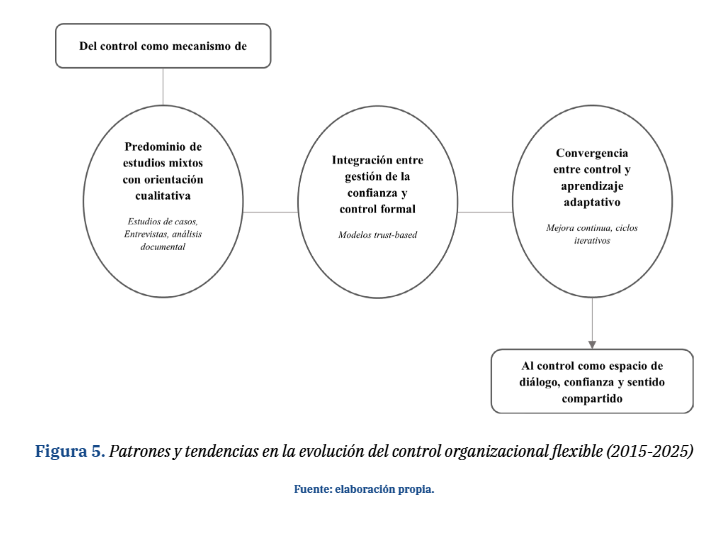
Figura 5:
) evidencian que el control organizacional contemporáneo transita hacia enfoques más adaptativos, en los que la integración entre mecanismos formales, confianza y aprendizaje continuo se consolida como eje de sostenibilidad organizacional. Este cambio refleja una transformación no solo técnica, sino también cultural, en la que el control se reconfigura como un proceso relacional orientado a la coordinación y la adaptación. En este contexto, el control flexible se posiciona como un elemento articulador entre estabilidad y cambio, abriendo paso al análisis de los vacíos y limitaciones aún presentes en la literatura. A partir de esta concepción, se propone un modelo conceptual integrador del control organizacional flexible que sintetiza cuatro dimensiones interrelacionadas identificadas en la literatura: las estructuras formales de control, la dimensión relacional basada en la confianza, el control adaptativo vinculado al aprendizaje organizacional, y las perspectivas complejas y transdisciplinarias. Estas dimensiones interactúan de manera dinámica, configurando un sistema de regulación que permite equilibrar estructura, autonomía y aprendizaje en contextos organizacionales caracterizados por la incertidumbre y la complejidad. El modelo conceptual derivado de esta revisión ( figura 6
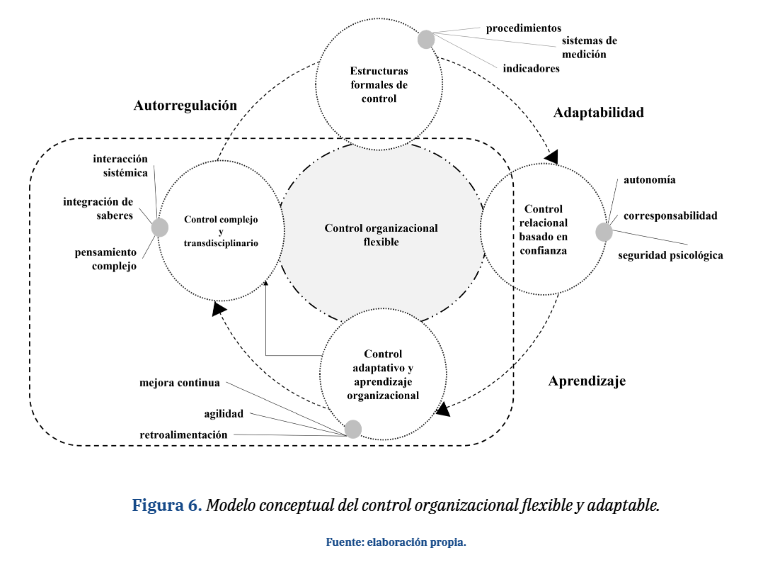
Figura 6:
) permite comprender el control organizacional flexible como una configuración dinámica que emerge de la interacción entre dichas dimensiones, trascendiendo la lógica tradicional de supervisión jerárquica y orientándose hacia formas de regulación más adaptativas. Desde el pensamiento complejo, estas dimensiones pueden interpretarse como componentes de un sistema autoorganizado en el que el orden, la autonomía y la retroalimentación coexisten de manera recursiva, permitiendo mantener coherencia sin limitar la capacidad de adaptación ( Morin, 2005 ). De forma complementaria, la transdisciplinariedad aporta un marco que integra dimensiones técnicas, humanas y simbólicas del control, reconociendo que la gestión organizacional se configura en la intersección de distintos niveles de realidad ( Nicolescu, 2002 ). En conjunto, el modelo sugiere que el control organizacional contemporáneo debe entenderse menos como un mecanismo de dominación y más como una arquitectura de coordinación, aprendizaje y construcción de sentido compartido. Esta reinterpretación permite dar paso al análisis de las implicaciones teóricas y organizacionales del control flexible en contextos caracterizados por la incertidumbre y la complejidad.
Discusión
La evolución del control organizacional hacia enfoques más flexibles, relacionales y adaptativos puede interpretarse como un cambio epistemológico que cuestiona la lógica mecanicista tradicional. Mientras los modelos clásicos concebían el control como un mecanismo de supervisión orientado al cumplimiento, los resultados de esta revisión evidencian su reconfiguración como un proceso dinámico de regulación que articula autonomía, aprendizaje y coordinación en contextos de incertidumbre. En este sentido, las dimensiones identificadas, estructuras formales de control, control relacional basado en la confianza, control adaptativo vinculado al aprendizaje organizacional y enfoques complejos y transdisciplinarios, deben entenderse como componentes interdependientes de un mismo proceso evolutivo. Este desplazamiento es coherente con el pensamiento complejo, que concibe a las organizaciones como sistemas dinámicos en los que el orden emerge de la interacción, la retroalimentación y la coexistencia de tensiones ( Morin, 2005 ). Desde esta perspectiva, el control deja de centrarse en la vigilancia para orientarse a la regulación de la relación entre autonomía y coordinación. La evidencia muestra que, en entornos ágiles, la construcción colectiva de indicadores y la gestión del error como fuente de aprendizaje fortalecen la capacidad adaptativa ( Koudriachov et al., 2025 ; Nöthel et al., 2023 ). De manera complementaria, la transdisciplinariedad amplía la comprensión del control al integrar dimensiones técnicas, humanas y simbólicas. A diferencia de los enfoques centrados exclusivamente en la medición y la jerarquía, los modelos contemporáneos incorporan elementos como la confianza, la cultura y la corresponsabilidad, situando el control en la intersección de distintos niveles de realidad ( Nicolescu, 2014 ). Esta perspectiva se ve reforzada por estudios sobre integración del conocimiento y sostenibilidad, que destacan la necesidad de articular saberes diversos para abordar la complejidad organizacional ( Fischer et al., 2025 ; Scholz, 2024 ). En esta línea, los resultados evidencian que los mecanismos informales, las relaciones, los significados y las prácticas cotidianas adquieren un papel central en la regulación organizacional. Este hallazgo contrasta con la tradición del control formal, al mostrar que su efectividad no depende exclusivamente de la supervisión, sino de la capacidad de las organizaciones para generar entornos de confianza y aprendizaje. Así, la convergencia entre control y aprendizaje adaptativo indica que las organizaciones dejan de operar bajo una lógica de corrección para orientarse hacia procesos continuos de mejora y ajuste. Desde el punto de vista práctico, estos resultados implican un replanteamiento de las formas de gestión. Las organizaciones requieren equilibrar mecanismos formales con dinámicas relacionales, fortaleciendo entornos de confianza, reflexión y aprendizaje continuo. En este contexto, el liderazgo se transforma, pasando de funciones de supervisión a la facilitación de procesos de coordinación y desarrollo organizacional ( Nöthel et al., 2023 ). Este enfoque se articula con el liderazgo adaptativo como competencia clave para gestionar la incertidumbre, al integrar sensibilidad contextual, reflexión ética y promoción de la autonomía responsable ( Sott y Sott, 2025 ). Asimismo, la incorporación de la sostenibilidad y la digitalización como dimensiones del control refuerzan la necesidad de métricas más integradoras que trasciendan los indicadores tradicionales ( Quesado et al., 2024 ). En términos organizacionales, esta transformación se expresa en la transición desde estructuras jerárquicas hacia configuraciones más participativas y multidisciplinarias, lo que favorece una mayor integración y capacidad de respuesta frente a la incertidumbre ( Cárdenas-Contreras et al., 2023 ). En este marco, la construcción de ambientes basados en la confianza, la innovación y el aprendizaje continuo se consolida como un elemento clave para la adaptación organizacional ( Salemi Toquica, 2022 ). Desde el plano investigativo, los hallazgos evidencian vacíos que abren nuevas oportunidades de estudio. Se requiere ampliar la investigación hacia contextos no occidentales, particularmente en América Latina y África, para construir una comprensión más contextualizada del control organizacional flexible. Asimismo, resulta necesario desarrollar instrumentos que permitan evaluar su efectividad en la práctica ( Fachrudin et al., 2024 ), así como promover enfoques metodológicos que integren múltiples disciplinas en coherencia con la complejidad del fenómeno ( Mehta et al., 2024 ). En relación con la formación del talento humano, el fortalecimiento del control flexible exige el desarrollo de competencias como pensamiento crítico, autonomía profesional, seguridad psicológica y aprendizaje continuo. La evidencia sugiere que el liderazgo adaptativo y las organizaciones de aprendizaje constituyen pilares para transformar culturas de control rígido en dinámicas basadas en la confianza y la corresponsabilidad ( Chughtai et al., 2023 ). En esta línea, la formación en pensamiento complejo y ética organizacional adquiere un papel central. En conjunto, estos hallazgos permiten sostener que el control organizacional flexible no constituye una simple adaptación de los modelos tradicionales, sino una reconfiguración profunda del paradigma de gestión ( Berdicchia et al, 2022 ). Esta transformación posiciona al control como un sistema de coordinación orientado al aprendizaje, la adaptación y la construcción de sentido compartido, más que como un mecanismo de dominación. Más allá de la síntesis de la literatura, este estudio aporta una interpretación integradora del control organizacional como un sistema dinámico de regulación que articula estructuras formales, relaciones de confianza, aprendizaje adaptativo y dinámicas complejas de interacción. Desde esta perspectiva, el control organizacional flexible puede entenderse como una capacidad em ergente que permite equilibrar estructura y autonomía en contextos de incertidumbre e interdependencia. Finalmente, los hallazgos abren nuevas líneas de investigación orientadas a analizar la implementación del control flexible en contextos específicos, así como su relación con la transformación digital y los sistemas basados en inteligencia artificial, lo que permitirá profundizar en la comprensión del control organizacional como un proceso adaptativo en entornos cada vez más complejos.
Conclusiones
El presente estudio permite afirmar que el control organizacional flexible constituye una transformación sustancial en la manera de concebir la gestión en las organizaciones contemporáneas. A partir del análisis sistemático de la literatura, se evidencia una transición desde enfoques centrados en la supervisión jerárquica hacia modelos de regulación organizacional basados en la confianza, el aprendizaje continuo y la adaptabilidad, lo que refleja un cambio en la lógica subyacente del control, desde el cumplimiento hacia la coordinación dinámica. En este marco, el control organizacional se configura como un sistema integrador en el que convergen estructuras formales, relaciones de confianza y procesos de aprendizaje, orientados a sostener la adaptabilidad en contextos de alta complejidad. Esta reconfiguración no implica la desaparición del control, sino su redefinición como un proceso relacional y dinámico que equilibra estructura y autonomía, permitiendo a las organizaciones responder de manera más efectiva a entornos caracterizados por la incertidumbre, la interdependencia y el cambio constante. El principal aporte del estudio radica en la identificación de patrones que evidencian la consolidación de un enfoque flexible del control organizacional, en el cual la eficacia no depende exclusivamente de la medición y la supervisión, sino de la capacidad de las organizaciones para construir sistemas de regulación basados en la interacción, la retroalimentación y la inteligencia colectiva. En este sentido, el control deja de ser un instrumento de vigilancia para convertirse en una capacidad organizacional que articula sentido, aprendizaje y acción. Asimismo, la integración de perspectivas asociadas a la complejidad y la transdisciplinariedad permite ampliar la comprensión del control más allá de su dimensión instrumental, situándolo como un proceso que articula dimensiones técnicas, humanas y éticas. Esta lectura contribuye a enriquecer el campo de los sistemas de control de gestión, al incorporar enfoques que reconocen la naturaleza dinámica y emergente de las organizaciones, así como la necesidad de abordar la gestión desde una perspectiva más holística e integradora. No obstante, el estudio presenta limitaciones relevantes. La concentración geográfica de la producción académica en contextos europeos y anglosajones restringe la comprensión intercultural del control organizacional flexible, mientras que la predominancia de enfoques descriptivos evidencia la necesidad de fortalecer el desarrollo de metodologías que permitan evaluar su impacto en el desempeño organizacional ( García Osma et al, 2022 ). Estas limitaciones abren la posibilidad de ampliar la investigación hacia contextos diversos, particularmente en América Latina y África, así como de avanzar en la construcción de indicadores que capten dimensiones cualitativas del control, como la confianza, el aprendizaje y la adaptabilidad. En términos prospectivos, el control organizacional flexible plantea desafíos y oportunidades para la investigación y la práctica. Por un lado, se requiere profundizar en el análisis de su implementación en contextos organizacionales específicos, considerando variables culturales, tecnológicas y sectoriales. Por otro, emerge la necesidad de explorar su articulación con procesos de transformación digital y el uso de sistemas basados en inteligencia artificial, lo que introduce nuevas tensiones entre automatización, autonomía y control. En conjunto, el control organizacional flexible se consolida como un enfoque emergente que invita a repensar las formas tradicionales de gestión, orientando la práctica organizacional hacia modelos más adaptativos, relacionales y sostenibles. Más que una tendencia, representa una reconfiguración del paradigma de control, en la que la capacidad de aprender, adaptarse y coordinar colectivamente se convierte en el principal recurso para la sostenibilidad organizacional en entornos complejos.
Financiación
Este artículo se desarrolla en el marco del proyecto de investigación “Gobernanza, sostenibilidad y transformación organizacional en las empresas y territorios emergentes” de la Corporación Universitaria de Sabaneta – unisabaneta , iniciativa orientada al fortalecimiento de las capacidades académicas, científicas e investigativas de los grupos de investigación institucionales. El proyecto tiene como propósito analizar y promover modelos organizacionales sostenibles, flexibles y adaptativos que contribuyan al desarrollo empresarial, la gobernanza territorial y la transformación estratégica de las organizaciones en contextos contemporáneos. Asimismo, busca fortalecer la productividad científica, la formación de talento humano y la generación de productos de investigación de alto impacto, en coherencia con las políticas institucionales de innovación, transferencia del conocimiento y responsabilidad social.
Conflictos de interés
Las autoras declaran no tener ningún conflicto de interés relacionado con la elaboración, desarrollo o publicación de este artículo. No existen intereses financieros, personales, institucionales ni académicos que pudieran haber influido de manera inapropiada en la interpretación de los resultados o en las conclusiones del estudio.
Declaración de uso de ia
En la elaboración de este artículo se utilizó una herramienta de inteligencia artificial generativa con fines de apoyo editorial y lingüístico. En específico, se empleó el modelo ChatGPT (OpenAI), GPT-5.2 Thinking, versión disponible en la plataforma de ChatGPT, con fecha de uso septiembre 2025 / febrero 2026. La ia se utilizó exclusivamente para: (i) mejorar la redacción académica (claridad, coherencia, cohesión y estilo), (ii) ajustar secciones a requisitos editoriales (p. ej., reorganización metodológica sin pérdida de contenido), y (iii) corregir el formato de citación en texto conforme a apa 7.ª edición, sin sustituir la autoría intelectual ni el análisis académico de las autoras. El uso de la herramienta se realizó mediante indicaciones escritas (prompts) formuladas por las autoras para guiar tareas específicas. A modo ilustrativo, se emplearon prompts como: “Reescribe la sección de Metodología en texto narrativo continuo, sin subtítulos, manteniendo toda la información original y agregando lo solicitado por la revista”; “Corrige y estandariza las citas en texto al formato apa 7, evitando dobles paréntesis y utilizando el orden y la puntuación adecuados”; y “Sugiere ajustes de estilo para evitar repeticiones y fortalecer la fluidez argumentativa en la introducción”. Las salidas generadas por la IA fueron revisadas críticamente, editadas y validadas por las autoras, quienes asumen la responsabilidad total por el contenido final del manuscrito, la precisión conceptual, la selección e interpretación de la literatura, así como la integridad de las citas y referencias. No se utilizó ia para generar datos, manipular resultados, ni para sustituir el proceso de análisis e interpretación de la revisión sistemática.
Problemática: en entornos organizacionales caracterizados por volatilidad, incertidumbre y transformación digital, los modelos tradicionales de control resultan insuficientes para gestionar la complejidad y promover la adaptabilidad. Objetivo: analizar la evolución del control organizacional desde una perspectiva flexible y adaptable, integrando los aportes del pensamiento complejo y la transdisciplinariedad, e identificando tendencias teóricas y empíricas en la literatura reciente. Metodología: se realizó una revisión sistemática cualitativa bajo el protocolo PRISMA. La búsqueda en bases de datos internacionales identificó 212 registros (2015-2025); tras depuración y evaluación de elegibilidad, se seleccionaron 30 estudios para el análisis. Resultados: se identifican tres tendencias principales: predominio de enfoques cualitativos centrados en mecanismos relacionales del control; integración entre control formal y confianza organizacional; y articulación con aprendizaje adaptativo y agilidad organizacional. Conclusión: el control organizacional contemporáneo se configura como un proceso relacional, complejo y adaptativo que integra estructuras formales, confianza y aprendizaje, orientado a equilibrar estructura y autonomía en contextos inciertos. Contribución/originalidad: el estudio aporta una visión original e integradora del control organizacional al incorporar el pensamiento complejo y la transdisciplinariedad como base para reinterpretar el control desde una lógica flexible, dinámica y adaptativa.
Problem Statement: In volatile and digitally transformed environments, traditional control models are insufficient to effectively manage complexity and foster adaptability. Objective: To analyze the evolution of organizational control through a flexible, adaptive lens, integrating complexity theory and transdisciplinarity to identify recent theoretical and empirical trends. Methodology: A qualitative systematic literature review was conducted using the PRISMA protocol. From 212 records identified in international academic databases (2015–2025), 30 studies met the strict eligibility criteria for final analysis. Results: Three primary trends emerged: a predominance of qualitative approaches focusing on relational control mechanisms; the integration of formal control with organizational trust; and the alignment of control with adaptive learning and agility. Conclusion: Contemporary organizational control operates as a relational, complex, and adaptive process that integrates formal structures, trust, and learning to balance stability and autonomy in uncertain environments. Contribution/Originality: This study provides an integrative perspective by applying complexity theory and transdisciplinarity to reinterpret organizational control through a flexible, dynamic, and adaptive logic.




References
Anthony, R. N., y Govindarajan, V. (2014). Management Control Systems (13th ed.). McGraw-Hill Education.
Bennett, N., y Lemoine, G. J. (2014). What VUCA really means for you. Harvard Business Review, 92(1–2), 27–42. https://hbr.org/2014/01/what-vuca-really-means-for-you
Bijlsma-Frankema, K., y Costa, A. C. (2019). Trust and Control Interrelations: New Perspectives. Routledge. https://doi.org/10.1177/1059601106293871
Cárdenas-Contreras, L. P., Palacios-Alvarado, W., y Carreño-Flórez, E. F. (2023). Importancia de la construcción de escenarios para el liderazgo transformacional en la gerencia moderna en Colombia. Dictamen Libre, (32), 53–63. https://doi.org/10.18041/2619-4244/dl.32.10401
Chughtai, M. S., Syed, F., Naseer, S. et al. (2023) El papel del liderazgo adaptativo en las organizaciones de aprendizaje para impulsar las innovaciones organizacionales con autoeficacia para el cambio. Current Psychology, 43, 27262–27281. https://doi.org/10.1007/s12144-023-04669-z
Dobrowolski, Z., Ledzianowski, J. y Dobrowolska, M. (2021). Towards agile management control systems at the university. European Research Studies Journal, 24, 497–512. https://doi.org/10.35808/ersj/2019
Edmondson, A. C., y Bransby, D. (2023). Psychological safety comes of age: Observed themes in 21st-century research. Annual Review of Organizational Psychology and Organizational Behavior, 10, 1–29. http://dx.doi.org/10.1146/annurev-orgpsych-120920-055217
Edmondson, A. C., y Lei, Z. (2014). Psychological safety: The history, renaissance, and future of an interpersonal construct. Annual Review of Organizational Psychology and Organizational Behavior, 1, 23–43. https://doi.org/10.1146/annurev-orgpsych-031413-091305
Fachrudin, A., Setiawan, D., Djuminah, D. y Risfandy, T. (2024). Explorando el desarrollo reciente del estudio de los sistemas de control de gestión. Cogent Business & Management, 11(1). https://doi.org/10.1080/23311975.2024.2357709
Fischer, C., Gugerell, K., Laa, U. et al. (2025). Evaluación de métodos transdisciplinarios: una nueva escala para medir la integración del conocimiento. Humanit Soc Sci Commun 12, 1395. https://doi.org/10.1057/s41599-025-05634-w
Flinkman, A., Gullkvist, B. y Teittinen, H.(2025). Formal control and trust in monitoring outsourcing. International Journal of Public Sector Management, 39(3), 288-304. https://doi.org/10.1108/IJPSM-03-2024-0062
Jiang, G., Warden, J., y Firth, N. (2023). Complexity leadership in action: A team science case study. Journal of Clinical and Translational Science, 7, e179. https://doi.org/10.1017/cts.2023.179
Johansson-Berg, T., y Siverbo, S. (2025). The emergence of control archetypes: Theorization of trust-based control. Journal of Accounting & Organizational Change, 102. https://doi.org/10.1016/j.cpa.2025.102809
Keegan, A., y Meijerink, J. (2025). Algorithmic Management in Organizations? From Edge Case to Center Stage. Annual Review of Organizational Psychology and Organizational Behavior. Advance online publication. https://doi.org/10.1146/annurev-orgpsych-110622-070928
Koudriachov, C., Tam, C., y Aparicio, M. (2025). Success with agile project management: Looking back and moving forward. Journal of Systems and Software, 12, 395-422. https://doi.org/10.1016/j.jss.2025.112428
Mehta, S. V., Polasky, S. y Tsakakis, E. (2024). The role of transdisciplinary approaches in environmental economics. Annual Review of Resource Economics, 16, 233-254. https://doi.org/10.1146/annurev-resource-101623-102715
Merchant, K. A., y Van der Stede, W. A. (2017). Management control systems: Performance measurement, evaluation and incentives (4th ed.). Pearson. https://elearn-archive.fnu.ac.fj/pluginfile.php/582221/mod_resource/content/1/Management%20control%20systems%20-%204th%20Ed.%20Pearson.pdf
Moher, D., Liberati, A., Tetzlaff, J., Altman, D. G., y The PRISMA Group. (2009). Preferred reporting items for systematic reviews and meta-analyses: The PRISMA statement. PLoS Medicine, 6(7), e1000097. https://doi.org/10.1371/journal.pmed.1000097
Morin, E. (2005). Introducción al pensamiento complejo. Gedisa. https://campus.unirep.edu.ec/pruebas/files/curseconten/constructivismo/recursos/documentos/u1doc1.pdf
Morin, E. (2011). La vía: Para el futuro de la humanidad. Paidós. https://edgarmorinmultiversidad.org/index.php/descarga-la-via-para-el-futuro-de-la- humanidad.html
Nicolescu, B. (2002). Manifesto of Transdisciplinarity. SUNY Press.
Nicolescu, B. (2014). From Modernity to Cosmodernity: Science, Culture, and Spirituality. SUNY Press.
https://ecosad.org/phocadownloadpap/otrospublicaciones/nicolescu-manifiesto.pdf
Nöthel, S., Nübold, A., y Uitdewilligen, S. (2023). Development and validation of the Adaptive Leadership Behavior Scale (ALBS). Frontiers in Psychology, 14. https://doi.org/10.3389/fpsyg.2023.1149371
Ouchi, W. G. (1979). A conceptual framework for the design of organizational control mechanisms. Management Science, 25(9), 833–848. https://doi.org/10.1287/mnsc.25.9.833
Page, M. J., McKenzie, J. E., Bossuyt, P. M., Boutron, I., Hoffmann, T. C., Mulrow, C. D., ... y Moher, D. (2021). The PRISMA 2020 statement: An updated guideline for reporting systematic reviews. BMJ, 372, n71. https://doi.org/10.1136/bmj.n71
Quesado, P., Silva, R., y Costa Oliveira, H. (2024). Management control systems and sustainability: A bibliometric analysis. Sustainability, 16(12), 5067. https://doi.org/10.3390/su16125067
Röttgen, C., Herbig, B., Weinmann, T., y Müller, A. (2024). Algorithmic management and human-centered task design: a conceptual synthesis from the perspective of action regulation and sociomaterial systems theory. Frontiers in Artificial Intelligence, 7. https://doi.org/10.3389/frai.2024.1441497
Salemi Toquica, J. L. (2022). La importancia del liderazgo servicial como generador de cambio cultural en las organizaciones. Dictamen Libre, (30). https://doi.org/10.18041/2619-4244/dl.30.8827
Scholz, R. W. (2024). Transdisciplinary knowledge integration–Part I. Technological Forecasting & Social Change, 202. https://doi.org/10.1016/j.techfore.2024.123281
Searle, R. H., Nienaber, A. M., y Sitkin, S. B. (2025). Trust and high control: An exploratory study. European Journal of Work and Organizational Psychology, 34(2), 255–273. 10.4324/9781315745572
Sott, M. K. y Sott, M. (2025). The role of adaptive leadership in times of crisis: Conceptual framework and propositions. Leadership in Organization, 5(1), 2, https://doi.org/10.3390/merits5010002
Simons, R. (1995). Levers of Control: How Managers Use Innovative Control Systems to Drive Strategic Renewal. Harvard Business Review Press. https://www.hbs.edu/faculty/Pages/item.aspx?num=257
Stacey, R. (2016). Tools and techniques of leadership and management: Meeting the challenge of complexity. Routledge.
Svare, H., Johnsen, Å., & Wittrock, C. (2023). Does trust-based management reform enhance employee-driven innovation? Evidence from a Scandinavian capital. Nordic Journal of Innovation in the Public Sector, 2(1), 43-58. https://doi.org/10.18261/njips.2.1.4
Teece, D. J. (2018). Business models and dynamic capabilities. Long Range Planning, 51(1), 40–49. https://doi.org/10.1016/j.lrp.2017.06.007
Uhl-Bien, M., Marion, R., & McKelvey, B. (2007). Complexity leadership theory: Shifting leadership from the industrial age to the knowledge era. The Leadership Quarterly, 18(4), 298–318. https://doi.org/10.1016/j.leaqua.2007.04.002
Weick, K. E. (1995). Sensemaking in organizations. Sage Publications.

This work is licensed under a Creative Commons Attribution-NonCommercial-ShareAlike 4.0 International License.
The authors transfer the patrimonial rights of their article to the Escuela Superior de Administración Pública - ESAP, while retaining the moral rights to their works. Articles in the journal Administración & Desarrollo are subject to the Creative Commons Attribution-Noncommercial-ShareAlike Attribution License that allows third parties to copy, reproduce, distribute, publicly communicate the work, and create derivative works, provided that the original author is cited and acknowledged, the first publication in this journal is indicated, the work is not used for commercial purposes, and the distribution of derivative works is done under a license of the same type.
The CC BY-NC-ND license was previously used, but it was changed to CC BY-NC-SA.