


Hacia mejores prácticas en el aprendizaje en línea: fomento de la autorregulación del alumnado Toward Best Practices in Online Learning: Fostering Student Self-Regulation
Main Article Content
-
Angélica Garzón Umerenkova
-
Pedro Organista Díaz
 https://orcid.org/0000-0002-6813-5521
How to Cite
Resumen
Se plantean las nuevas necesidades de la sociedad del aprendizaje continuo, que surgen a partir del uso de los entornos virtuales de aprendizaje antes y posteriores al COVID-19. Se realizó una revisión actualizada de la literatura y de algunas de las teorías sobre la metacognición y la autorregulación, para dar respuesta a los nuevos retos de los aprendices, tutores y diseñadores del aprendizaje en línea. Se discuten las ventajas que ofrece el fomento de la autorregulación en los aprendices en línea, y sobre sus competencias para aprender, y se ofrece una guía práctica para tutores. La evidencia señala que incorporar un entrenamiento explícito o implícito en autorregulación genera en los estudiantes un mejor rendimiento y calidad del aprendizaje. Se presentan siete pautas para mejorar la planificación, que van desde la evaluación preliminar de la capacidad de autorregulación del estudiante hasta el fomento de la metacognición,el automonitoreo y la motivación.
Palabras clave:
aprendizaje autorregulado, aprendizaje virtual, metacognición, calidad de la educación, aprender a aprender..Abstract
The new needs of the continuous learning society, arising from the use of virtual learning environments before and after COVID-19, are discussed. An updated review of the literature and some of the theories on metacognition and self-regulation was carried out to respond to the new challenges of learners, tutors and designers of online learning. The advantages of fostering self-regulation in online learners and their learning competencies are discussed, and a practical guide for tutors is offered. Evidence indicates that incorporating explicit or implicit training in self-regulation generates better performance and quality of learning in students. Seven guidelines for improving planning are presented, ranging from preliminary assessment of the student's self-regulation skills to fostering metacognition, self-monitoring, and motivation.
Key words:
self-regulated learning, virtual learning, metacognition, educational quality, learning to learn..INTRODUCCIÓN
La proliferación en todo el mundo de la educación a través de entornos virtuales es una oportunidad para expandir el acceso a la educación, con posibles ganancias en la flexibilidad espaciotemporal y en los procesos y experiencias de aprendizaje para los estudiantes, haciéndolo cada vez más amplio y diverso, lo que conlleva a su vez a la necesidad de generar nuevos acercamientos pedagógicos para cubrir las diferentes necesidades de un alumnado cada vez más heterogéneo (Fermín-González, 2019).
De igual manera, los cursos abiertos masivos en línea permiten que los estudiantes desarrollen su aprendizaje con poca monitorización externa de los docentes (Wong et al., 2019), o que puede ser combinada con la enseñanza tradicional presencial. Dada su relevancia, desde inicios de siglo, algunos autores han afirmado que el reto central de la psicología educativa hoy es comprender mejor la naturaleza del aprendizaje virtual (Bernard et al., 2004).
La pandemia del COVID-19 impulsó a que millones de estudiantes y profesores en todo el planeta tuvieran que adaptarse a un contexto virtual de enseñanza-aprendizaje, dando una nueva dimensión a los retos de la educación a través de contextos de educación virtual. La tendencia global, anterior a la pandemia hacia la digitalización y dataficación de la educación, parece haber alcanzado otro nivel (Teras et al., 2020) y ha llegado para quedarse.
Sin embargo, a pesar del aumento exponencial del aprendizaje en línea, al parecer no todos los estudiantes tienen éxito en esta modalidad de aprendizaje, situación que está demostrada por los elevados niveles de deserción, a pesar de las mejoras en flexibilidad y contenido promovidas en los últimos años (Coussement et al., 2020).
De esta manera, este documento presenta una revisión teórica sobre algunos tópicos relevantes frente a la mejora de la calidad del aprendizaje en línea, particularmente, en lo referente a la implementación de mejoras en la autorregulación académica en el alumnado, sus posibles efectos sobre la metacognición y las competencias para aprender a aprender. Se toman en cuenta también algunas recomendaciones prácticas para el mejoramiento de los procesos de aprendizaje virtual, las cuales pueden ser incorporadas total o parcialmente por los tutores, educadores o diseñadores de cursos en línea.
Necesidades de los estudiantes en línea
Los antecedentes de la literatura indican claramente que, en los entornos tradicionales de aprendizaje, la autorregulación académica, la confianza y autoeficacia del alumnado, predicen el rendimiento e influyen en su bienestar y calidad de vida como estudiantes (De la Fuente et al., 2021; Garzón et al., 2018). Por el contrario, la procrastinación, la falta de habilidades para la gestión del tiempo y la planificación, no solo impactan negativamente en el rendimiento académico (Garzón & Gil, 2017), también generan estrés (De la Fuente et al., 2020), vulnerabilidad psicológica y problemas de salud en el alumnado (Garzón et al., 2018).
Teniendo en cuenta los antecedentes que señalan la importancia de las capacidades de autorregulación, confianza, autoeficacia o planificación en modalidad presencial, en los entornos de aprendizaje virtual, es pertinente preguntarse si estas variables tienen igual o mayor capacidad predictiva sobre el rendimiento académico y la salud de los estudiantes.
Se han identificado algunas de las variables contextuales que influyen en la permanencia de los estudiantes en línea, tales como dificultades para contactar al tutor o poca experiencia pedagógica, lo que genera en los estudiantes la sensación de estar solos en su proceso de aprendizaje (Yang & Cornelius, 2004). De igual manera, disminuyen la permanencia en esta modalidad de aprendizaje, las realimentaciones y los mensajes o correos. Una parte significativa de la formación en línea consiste en cursos pobremente diseñados, con instructores inexpertos (Frankola, 2001), con dificultades no solo en los aspectos didácticos, sino también en los cognitivos y emocionales (Lovos & Aballay, 2020).
Como variables personales de los aprendices, los entornos virtuales de aprendizaje requieren de los estudiantes mayor autonomía y responsabilidad en su propia educación, es decir, requieren altos niveles de autorregulación académica (Dabbagh y Kitsantas, 2004). Algunos estudiantes matriculan un número excesivo de cursos en línea, lo que indica una debilidad de los servicios de consejería, al igual que cuando los estudiantes no entienden su rol como estudiantes virtuales.
Por el contrario, quienes principalmente se benefician de los entornos virtuales de aprendizaje son quienes presentan mayor autonomía, planifican adecuadamente su tiempo de estudio y tienen un adecuado nivel de concentración, autoeficacia y alfabetización digital (Barbour & Reeves, 2009; Booker & Rebman, 2005). Así, las habilidades de autorregulación y autoeficacia son predictores del éxito académico en los aprendices en modalidad virtual (Bernal et al., 2020).
Gracias a la identificación de estas y otras variables contextuales y personales relacionadas con el éxito del aprendizaje virtual, a través de estudios previos, se ha justificado el marco de referencia del aprendizaje autorregulado, para comprender, modificar y entrenar con éxito aspectos que afectan el desempeño de los aprendices en línea (Banihashem et al., 2021; Heller, 2020; Stephen & Rockinson-Szapkiw, 2021; Winters et al., 2008).
De acuerdo con los resultados de la revisión sistemática realizada por Wong et al. (2019), debido a la diversidad de estudiantes que se vinculan a los entornos de aprendizaje masivos, es importante apoyar las estrategias de aprendizaje autorregulado del alumnado. Tras analizar 35 estudios publicados sobre el efecto de la autorregulación en cursos virtuales masivos, los au
tores encontraron que existen estrategias para que la autorregulación efectivamente ayude al aprendizaje en línea (por ejemplo, indicadores, notificaciones, retroalimentación o sistemas integrados de apoyo), a pesar del hecho de que existen diferencias individuales en cuanto a qué beneficia más a un alumno que a otro.
Sin embargo, a pesar del potencial beneficio que tiene el fomento de la autorregulación en los aprendices en línea, no se ha llegado a implementar en la práctica ni de manera integral. Lai & Hwang (2021) analizaron los resultados de publicaciones realizadas en la década del 2010 al 2020, con la implementación de la autorregulación en el aprendizaje en línea y encontraron que en el 58% de los estudios no fueron tenidos en cuenta las etapas previas y básicas de la autorregulación (planeación, búsqueda de información, repaso, memorización) y que en el 40% de los estudios no se hacía explícito cómo los resultados podían tener implicaciones prácticas.
Aunque probablemente queda mucho camino por recorrer, tal vez el punto de partida sea preguntarse cómo fomentar las competencias de autorregulación a través de los cursos virtuales, como medio para incrementar tanto la permanencia de los estudiantes como la calidad del aprendizaje virtual. Desde esta perspectiva, el proceso de enseñanza y aprendizaje a través de entornos virtuales ofrece un reto doble; por una parte, exige a los aprendices mejorar sus competencias de autorregulación y metacognición, por las exigencias propias de la naturaleza de esta modalidad de enseñanza expuestas previamente; por otra parte, obliga a los diseñadores y pedagogos a incorporar elementos instruccionales innovadores provenientes del amplio cuerpo de investigaciones sobre la autorregulación y la metacognición para mejorar la calidad de la instrucción, ofreciendo a los estudiantes opciones para potenciar su capacidad de aprender a aprender.
DESARROLLO
El contexto de la sociedad del aprendizaje
Los cambios culturales, las tecnologías de la comunicación y la información, el cambio de las relaciones económicas en torno al privilegio del conocimiento y el aprendizaje sobre los recursos físicos como índice de ventaja competitiva entre las naciones (Porter, 1991) y el desarrollo de las teorías del aprendizaje, entre otras múltiples aristas, han conducido a lo que algunos autores han llamado la sociedad del aprendizaje continuo (Pozo & Monereo, 1999), contexto que ha definido nuevas formas de relación entre los estudiantes, los docentes y el conocimiento, modificando sustancialmente los principios de la organización educativa e incluso sus objetivos.
En este entorno, tiende a hablarse del constructivismo como el marco epistemológico, conceptual y metodológico, actualmente más aceptado para orientar los procesos educativos (Serrano & Pons, 2011), incluso en entornos virtuales (Barbera, 2004), lo que implica que el variopinto grupo de enfoques, modelos y propuestas que se sintonizan con esta forma de entender y actuar en los procesos de aprendizaje y enseñanza, tienen en común, de acuerdo con Díaz & Hernández (2010), el énfasis en el protagonismo de los estudiantes en calidad de sujetos cognoscentes y activos en el proceso de construcción del conocimiento.
Si bien, hay relativo acuerdo sobre la adecuación de este enfoque para vehiculizar los procesos de aprendizaje y enseñanza, aún no es suficientemente claro cómo estos postulados satisfacen la formación en entornos virtuales. Es claro que el objetivo sigue siendo la formación del pensamiento crítico, la formación integral, la construcción conjunta del conocimiento y el desarrollo de estrategias de aprendizaje, entre otros aspectos, pero no es igualmente claro cómo favorecer tales principios por medio de las herramientas digitales, sin los espacios y tiempos convencionales.
Esta circunstancia genera conflictos para los diseñadores y docentes de los programas de formación virtual, porque el control no se deriva ya de la conducta en un salón de clase, ni de la transmisión de un discurso magistral; al contrario, hay un mayor peso en las expectativas, en las creencias, en las motivaciones y en las concepciones previas de los estudiantes, es decir, en la motivación intrínseca (Rodríguez, 2009) y se requiere que los docentes incorporen nuevas prácticas de enseñanza mediante el uso de las tecnologías de la información y la comunicación (Alonso-García et al., 2019). Las nuevas formas de entender el aprendizaje nos llevan necesariamente a la autorregulación como un objetivo básico de la educación superior.
Marco de referencia sobre el aprendizaje autorregulado y la metacognición
El concepto de autorregulación tiene sus antecedentes en el constructo teórico de la conciencia, uno de los ejes centrales en la historia de la psicología, pues ha orientado la definición de enfoques desde el mismo Wundt, de quien se dice fundó en 1879 la psicología como ciencia (Boring, 1999), y para quien la conciencia fue su objeto de estudio. Este mismo camino fue seguido por la psicología histórico-cultural de Vigotsky, desde la que se busca comprender el proceso socio genético, a través del cual, los individuos al final de la infancia interiorizan el conocimiento y construyen su conciencia a través de la mediación social (Vygotski, 1987; 1989).
Piaget, otro de los grandes gestores de las actuales visiones sobre el aprendizaje, no fue ajeno a esta orientación y postuló la aparición de la conciencia como parte del desarrollo cognitivo (Piaget, 1980), vinculado a lo conceptual y lo representacional, y cuya principal característica es formalizar por la acción reflexiva, lo que en etapas inferiores del desarrollo opera como actividad práctica (Piaget, 1970), lo que redundaría en la eliminación del conflicto cognitivo.
De esta forma, la regulación cognitiva y conductual, la capacidad de planeación y la capacidad de reflexión, entre otros aspectos de la autorregulación, son previos en la historia y las teorías educativas.
Más recientemente, Flavell (1985) es reconocido como el primer teórico en definir la metacognición. Si bien no hay total acuerdo, la mayoría de los investigadores diferencia dos grandes componentes: uno de orden declarativo, denominado metaconocimiento y dividido por Flavell en conocimiento de persona, tarea y estrategia, y otro con énfasis procedimental, denominado estrategias metacognitivas y que podemos organizar en planeación, control y evaluación (Brown, 1987).
Además del tipo de conocimiento (declarativo o procedimental), la metacognición influye en el proceso de aprendizaje de acuerdo con el nivel de exigencia cognitiva -desde procesos automáticos, hasta procesos que exigen concienciay con el nivel de explicitación o conciencia del conocimiento: desde el conocimiento implícito hasta el explícito (Organista, 2005).
Si bien la metacognición se ha configurado como un robusto cuerpo de investigaciones en función de la explicación del aprendizaje académico los modelos actuales han involucrado el metaconocimiento y las estrategias metacognitivas dentro de modelos multidimensionales, siendo el eje la autorregulación, como se examina a continuación.
La autorregulación del aprendizaje se define como la capacidad de los estudiantes para planear su proceso de manera activa desde un punto de vista metacognitivo, siendo conscientes de sus características cognitivas, motivacionales y conductuales (Schunk & Zimmerman, 1989; Zimmerman, 1996).
En seguimiento del eje argumental de este documento, es pertinente continuar el análisis de la autorregulación en su calidad de aspecto determinante de la educación mediada por las tecnologías. Los ambientes de aprendizaje virtual exigen mayores herramientas metacognitivas en cuanto a tópicos tales como la autonomía (Henao, 2002), la claridad en la definición y seguimiento de las metas; la elección de los programas, medios y estrategias de aprendizaje; la toma de decisiones sobre la organización del trabajo, el manejo de los tiempos, la evaluación y el conocimiento de técnicas, estrategias y procedimientos para estudiar y aprender (Hernández & Rodríguez, 2002). Es decir, los estudiantes requieren mayores competencias para analizar su propio pensamiento, para planificar, monitorear, autorregular y modificar su proceso de aprendizaje (Laskey & Hetzel, 2010). Junto con ello, el aprendizaje en línea demanda competencias actitudinales y procedimentales para interactuar y colaborar en entornos de trabajo grupales, utilizando correctamente los recursos disponibles y distribuyendo tareas (Sanhueza, 2006).
Para los cursos masivos virtuales, se han identificado una serie de características de autorregulación que favorecen el aprendizaje, entre las que se cuentan la autoeficacia y la regulación de la motivación. Como estrategias conductuales regulatorias, se cuentan la búsqueda de ayuda, la gestión del tiempo y el esfuerzo regulatorio de los estudiantes (Lee et al., 2019).
En las últimas décadas, diferentes modelos teóricos han tratado de identificar los procesos que intervienen en la autorregulación del aprendizaje. El modelo de Pintrich (2000), basado en aspectos sociocognitivos, ofrece la visión más amplia, sintética y aceptada. El modelo contiene cuatro fases: planeación, automonitoreo, autocontrol y evaluación. Las cuatro fases son patrón general, aunque no constituyen un patrón lineal. Cada fase incluye, a su vez, aspectos cognitivos, motivacionales/afectivos, conductuales y contextuales. En las siguientes páginas del texto, se retomará este modelo para ejemplificar el uso de actividades en línea para el fomento de la autorregulación.
Ventajas del aprendizaje en línea para el fomento de la autorregulación
Las investigaciones mencionadas, indican que la autorregulación favorece el aprendizaje en entornos virtuales. Este aporte es bidireccional, en cuanto que los entornos virtuales de aprendizaje también ofrecen algunas ventajas para el fomento de la autorregulación frente a los entornos tradicionales, puesto que ofrecen una serie de recursos, formas de interacción y medios potencialmente benéficos para el desarrollo de competencias autorregulatorias en los estudiantes, y para la innovación pedagógica en general. Por ejemplo, si hablamos específicamente de la compleja y dinámica relación entre el aprendizaje autorregulado y el m-learning (aprendizaje móvil), hay evidencia de que el m-learning promueve la autorregulación del aprendizaje y que la autorregulación favorece el m-learning (Palalas & Wark, 2020).
A continuación, se mencionan algunas de estas ventajas, con base en Coll (2008) y Joint Information Systems Committee (JISC, 2010; 2007), organismo especializado en el desarrollo de políticas para la educación superior en el Reino Unido.
Inmediatez y facilidad de retroalimentación. A través de los entornos virtuales de aprendizaje, los resultados de una actividad se pueden entregar de manera inmediata. Son diversas las herramientas en línea que permiten a los estudiantes participar de manera sincrónica (por ejemplo, a través de dispositivos móviles o cuestionarios en línea), lo que puede facilitar la microevaluación y el automonitoreo. La rapidez en la retroalimentación facilita el aprendizaje y fomenta la autorregulación (JISC, 2010).
Diversidad de interacciones. La variedad de canales y herramientas de comunicación en línea pueden facilitar la interacción y realimentación durante el proceso de aprendizaje. Por otro lado, la precisión en el uso del lenguaje (con mayor razón cuando no se cuenta con las claves no verbales gestuales, prosódicas y de lenguaje corporal), con la posibilidad de retomar permanentemente las observaciones, que ya no obedecen solo a una situación asincrónica, hace que los comentarios de los docentes sean más asertivos, en términos de ofrecer información clara, precisa, objetiva y operacionalizada, con indicación de los aspectos positivos y los que deben mejorarse.
Validez ecológica. Cuando la plataforma de aprendizaje en línea emplea simulaciones, realidad virtual, realidad aumentada u holografía, estas pueden apoyar la transferencia de lo aprendido al mundo real.
Andamiaje y aprendizaje autorregulado. Los tutores virtuales, los recursos en línea o los agentes virtuales creados para el apoyo al aprendizaje pueden servir como andamiajes para el aprendizaje (en inglés "scaffolding"), concepto introducido por Wood et al. (1976), con base en los postulados de Vigotsky.
El andamiaje es una metáfora sobre el uso de "andamios" por parte del maestro o tutor para facilitar la construcción del conocimiento en el estudiante; en la medida que el conocimiento se va construyendo, el apoyo externo (andamio o regulación externa) se retira. En un experimento realizado por Song & Kim (2020) se encontró que el grupo experimental sometido a un diálogo con una agente virtual inteligente que servía de andamiaje mostró un incremento mayor de autorregulación frente al grupo control, al que tan solo se dio información sobre qué es la autorregulación, pero no se le brindó andamiaje.
Fomento de la autorregulación y la metacognición a través del aprendizaje en línea
La educación mediada por tecnologías, a pesar de ser un área de investigación diversa y compleja, se ha concentrado en tres áreas de estudio: diseño, cognición y contexto (Dillon & Jobst, 2005). El diseño hace referencia a los estudios que atienden las diversas formas de estructura de la plataforma y de la información usadas en la implementación de entornos virtuales de aprendizaje. La cognición estudia las variables psicológicas y las diferencias individuales de los aprendices y, finalmente, en el área del contexto, se examinan las situaciones de aprendizaje y el impacto del uso de los medios virtuales sobre el aprendizaje.
Aunque la investigación sobre autorregulación del aprendizaje y la metacognición en entornos virtuales ha sido cubierta parcialmente en algunas de estas áreas expuestas, o en la combinación de ellas (Azevedo, 2020), existen, como lo señalan Azevedo & Witherspoon (2009), una serie de problemas cruciales que son objeto constante de investigación educativa, tales como la manera en que el estudiante regula su aprendizaje en un entorno virtual mediante una interacción entre las demandas de la tarea, las características del aprendiz y los procesos cognitivos y metacognitivos cíclicos, en las diferentes fases del proceso de autorregulación.
A raíz de la pandemia por la COVID-19, la implementación de estrategias para la mejora del aprendizaje en línea se ha acelerado. En una investigación exploratoria realizada por Infante et al. (2021) se indagó sobre el uso de aplicaciones digitales en la docencia universitaria para la promoción de la autorregulación del aprendizaje en línea. Los autores identificaron 27 aplicaciones empleadas por los docentes que tenían relevancia para facilitar la autorregulación del aprendizaje. Sin embargo, cabe resaltar que la mayoría de estas aplicaciones no fueron diseñadas para la promoción de la autorregulación, siendo efectivas solo por la participación activa del docente, la forma en que las incorporó en las actividades académicas programadas y su propuesta didáctica (Infante et al., 2021).
En ese orden de ideas, herramientas que no han sido creadas originalmente para fomentar la autorregulación pueden cumplir con este propósito en tanto que el docente las incorpora en su actividad pedagógica.
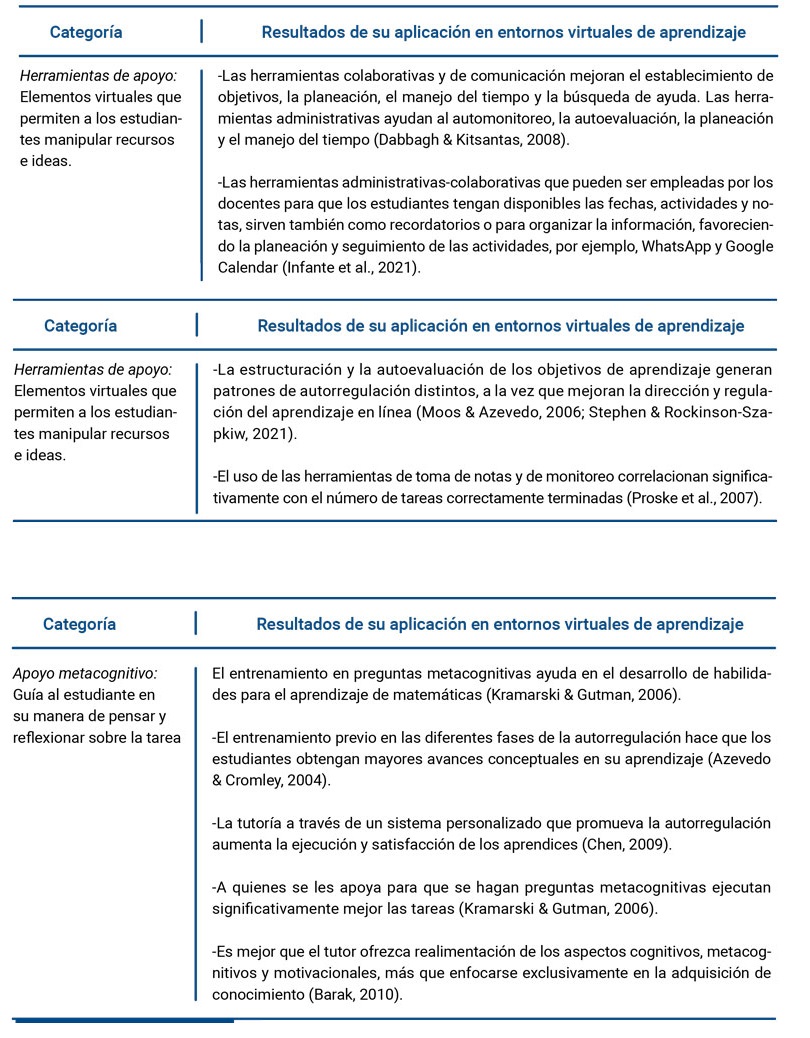
Siguiendo la clasificación propuesta por Winters et al. (2008), los apoyos o condiciones que ofrecen los entornos virtuales y que facilitan el mejoramiento de la calidad de la autorregulación de los estudiantes pueden dividirse en tres categorías generales: a) herramientas dentro del ambiente virtual que permiten a los estudiantes manipular recursos e ideas como tomar notas, resaltar texto, herramientas de creación y comunicación; b) apoyos conceptuales dentro o fuera del entorno virtual que guían al estudiante para la comprensión de contenidos, andamiajes estáticos o adaptativos para la comprensión conceptual, y c) apoyos metacognitivos que guían al estudiante en las formas de pensar y reflexionar en su tarea, por ejemplo, en el entrenamiento en señales o avisos para el automonitoreo y la reflexión.
A partir de esta clasificación, y con la intención de aportar mayor claridad, en la Tabla 1 se eligen algunos ejemplos concretos representativos de experiencias exitosas que han sido investigados en el aprendizaje a través de entornos virtuales, para aumentar o crear competencia de autorregulación académica.
Fuente: elaboración propia
Tabla 1: Algunos usos de herramientas virtuales para mejorar la autorregulación y la metacognición.
Condiciones educativas para el fomento de la autorregulación
A partir de la evidencia que se acaba de presentar y de la revisión de Artino & loannou (2008), cuyo trabajo es resultado de una exhaustiva lectura de la literatura sobre estudios de autorregulación aplicados al aprendizaje en línea entre los años 1995 a 2007, pueden identificarse algunas experiencias exitosas que pueden servir de base para el proceso instruccional basado en la autorregulación.
Primera. Quienes tienen perfiles más adaptativos tienen más éxito en el aprendizaje virtual. En ese sentido, en la planificación de un curso virtual es importante evaluar los componentes del aprendizaje autorregulado de los estudiantes, para ello, se pueden emplear cuestionarios, ofreciendo una realimentación individualizada. Los resultados de los cuestionarios pueden también servir al tutor virtual para enviar a los estudiantes mensajes reflexivos con los que promover su automonitoreo, al igual que para crear tareas y rúbricas de apoyo al establecimiento de objetivos y a la autoevaluación.
Segunda. De acuerdo con la evidencia, las creencias motivacionales de los estudiantes son relevantes dentro del proceso pedagógico (autoeficacia, motivación intrínseca y valor de la tarea, entre otras). En esta línea, por ejemplo, se puede aumentar el valor de la tarea discutiendo al inicio de una actividad la importancia de esta, diseñando actividades en línea que estén basadas en problemas auténticos, reflexionando con los estudiantes sobre qué tipo de tareas específicas de aprendizaje pueden contribuir a la realización de sus metas personales, intereses y valores, o empleando sistemas dinámicos y sincrónicos (dispositivos móviles y redes sociales, por ejemplo).
Tercera. A pesar del uso generalizado de los foros de debate en línea, se ha encontrado que los estudiantes raramente usan sus habilidades de pensamiento crítico durante estas discusiones, decantándose por un tratamiento más bien superficial de los temas. Ofrecer un andamiaje apropiado a las discusiones en línea puede aumentar el uso de herramientas metacognitivas. En ese sentido, el tutor puede, mediante comentarios explícitos y aclaración de los criterios argumentativos, modelar y ejemplificar discusiones apropiadas que se enfoquen en los temas y conceptos específicos de debate. Lui et al. (2006) reportan una actividad en la que los estudiantes podían expresar libremente sus ideas de manera reflexiva en combinación con la realimentación y el apoyo de pares. En esta actividad, un grupo de estudiantes de primer año de ingeniería de software debía escribir un blog reflexivo como respuesta a preguntas hechas por el tutor y otros estudiantes. Los blogs, por lo tanto, fueron utilizados para compartir conocimiento y como un espacio de trabajo e información.
Cuarta. Se ha demostrado que los estudiantes que buscan ayuda de otros y colaboran con los demás tienen más éxito en los entornos virtuales. En coherencia con este hallazgo, es importante fomentar la colaboración y corregulación, por ejemplo, al usar a los pares como modelos de discusiones apropiadas, reconocer explícitamente los comentarios de los estudiantes que estén bien escritos, ofrecer ejemplos de tareas modelo de los estudiantes destacados o usar proyectos de grupo que promuevan que los estudiantes trabajen juntos dirigidos hacia un mismo objetivo. English & Duncan (2008) promovieron en un grupo de estudiantes de magisterio el uso de Facebook durante su práctica de maestros, para facilitar el compartir historias y anécdotas. Los resultados indican que se promovió la autodirección de su propio aprendizaje ya que los practicantes crearon, compartieron y comentaron las contribuciones de los demás, permitiendo crear diversas formas de apoyo de pares.
Específicamente, en los entornos virtuales de aprendizaje mixto (blended learning) la literatura señala que algunas características pueden ser tenidas en cuenta, ya que favorecen el desarrollo de habilidades de autorregulación por parte del alumnado, entre ellas: autenticidad, personalización, control del aprendizaje, andamiaje, interacción y señales para la reflexión (Van & Elen, 2016).
Otros nodos temáticos relacionados con el aprendizaje en línea
Tanto la autorregulación como la metacognición son temas centrales en el contexto educativo, por lo que han sido abordados en la investigación sobre otros grandes temas de interés en el aprendizaje y la enseñanza virtual. En esta sección examinaremos los vínculos entre los dos temas que se han venido examinando y otros tópicos de investigación que están apoyando la ampliación del conocimiento en el área.
Creencias epistémicas. De acuerdo con Winters et al. (2008) y Martínez et al. (2009), en la formación virtual es necesario analizar las creencias epistémicas por su implicación en la motivación, el aprendizaje y la autorregulación. El aprendizaje que se produce con la intervención de estrategias de autorregulación no se limita a una información o a un dominio específico, sino que debe reflejarse en las competencias para el aprendizaje. El aprendizaje virtual puede facilitar la elaboración de una epistemología personal por hacer más reflexiva la búsqueda de información, la toma de decisiones y la comunicación, probablemente, como consecuencia del monitoreo y la evaluación metacognitiva que estos entornos implican (Muis, 2007).
En el uso de Internet, Braten & Stromso (2009) y Stromso y Braten (2010) encontraron que las personas con creencias epistémicas favorables hacia la utilidad de esta herramienta como fuente de conocimiento, hacia la búsqueda de ayuda y sobre la autorregulación en el aprendizaje (puntualmente en la planeación, el monitoreo y la regulación), obtienen mejores resultados, mientras que quienes tienden a creer que el aprendizaje basado en computadores requieren menor planeación y organización, muestran mayores dificultades para adaptarse a estos entornos de aprendizaje.
Enseñanza de habilidades metacognitivas. DeStefano & Lefevre (2007) encontraron que la interactividad del aprendizaje virtual, específicamente en hipertextos, no necesariamente mejora el aprendizaje, especialmente en el caso de estudiantes con bajas competencias, mientras que la estructuración del material sí mejoraba los resultados. Así, las estrategias metacognitivas que promuevan la reflexión y la ordenación del material, tales como cuestionarios metacognitivos previos a la tarea, ejercicios de anticipación y la planeación de resultados, favorecen el aprendizaje (Núñez et al., 2011). Algunos ejemplos de preguntas metacognitivas son: ¿Piensas que conoces el tema? ¿Tienes claro el significado de...? ¿Piensa cómo puedes relacionar la información con.? ¿Reflexiona sobre qué pasos debes seguir.? ¿Piensa en qué tipo de dificultades tienes para.? ¿Piensa en cómo puedes resolverlas? ¿Reflexiona en qué eres sistemático? ¿Piensa en cuánto interés tienes en la tarea?
Tesouro (2004) ofrece un ejemplo de cómo se puede fomentar la metacognición a través de la evaluación en entornos virtuales. En este enfoque, la evaluación forma parte integral del proceso instruccional y fomenta los procesos cognitivos y metacognitivos. Sugiere iniciar por activar el aprendizaje previo de los estudiantes, remitiendo a ejemplos de actividades anteriores. Igualmente, para activar la metacognición de los estudiantes recomienda hacer una corrección reflexiva de los posibles errores de interpretación del ejercicio desarrollado. Por otra parte, para fomentar la capacidad metacognitiva es importante la autoevaluación, la coevaluación y discutirlas preguntas de los exámenes con posterioridad a su calificación, a modo de realimentación cognitiva complementaria a la nota obtenida.
Aprendizaje basado en problemas (ABP). Investigaciones con experiencias en el fomento de la autorregulación en entornos presenciales muestran la utilidad de la discusión explícita de los objetivos de aprendizaje, de la naturaleza de la tarea y de las estrategias de resolución de problemas empleadas con los estudiantes (Barak, 2010). Justamente, el partir de situaciones problema es una estrategia que implica la activación de procesos de metaconocimiento, de planeación, de control y de evaluación metacognitiva. La estrategia denominada Aprendizaje Basado en Problemas (ABP) se ha empleado tanto en entornos presenciales como en los virtuales. Desde esta vía se promueve la participación activa de los estudiantes en cada una de las fases del proceso de aprendizaje, incluyendo la definición de los problemas, de los objetivos, de los contenidos, de las formas de evaluación y, en general, de todo el proceso de construcción de conocimiento.
Otra forma de abordar el aprendizaje virtual mediante estrategias que implican solución de problemas son las tareas de investigación tales como las implicadas en los webquest y estrategias semejantes. Por ejemplo, Quaresma & Oliveira (2009) incluyeron un webquest como actividad en un curso de informática educativa, haciendo énfasis en la planeación y el monitoreo, así como en la evaluación de las dificultades del proceso, lo que contribuyó a la comprensión del tema.
Automonitoreo y planificación. A través del monitoreo, el aprendiz compara los productos de aprendizaje con los criterios o estándares para determinar si en esa fase de aprendizaje de una tarea, los objetivos han sido alcanzados, o si es necesario realizar más trabajo para alcanzarlos. Los estudios de Azevedo y Witherspoon (2009), específicamente, en los entornos virtuales, señalan que al menos existen ocho tipos de monitoreo que los estudiantes despliegan y que si se apoyan todos o algunos de ellos durante el proceso de aprendizaje, la ejecución y comprensión de los estudiantes mejora significativamente. Se presentan a continuación:
-
Sensación de conocimiento: el estudiante se da cuenta si tiene o no alguna familiaridad previa con el material.
-
Juicio de aprendizaje: el aprendiz se da cuenta si está o no entendiendo lo que está leyendo.
-
Uso de estrategias: en el que el estudiante se da cuenta si la estrategia que está usando le es útil o no para aprender.
-
Auto-prueba: el estudiante se hace a sí mismo alguna pregunta para determinar si está comprendiendo y determina si debe reajustar su proceso de aprendizaje.
-
Hacia la meta: el estudiante valora si ha conseguido avanzar completando las etapas previas de aprendizaje.
-
Monitoreo del tiempo: el estudiante es consciente del tiempo que ha dedicado para la tarea de aprendizaje.
-
Evaluación de contenido: el estudiante monitorea lo apropiado o inapropiado del contenido que está estudiando en ese momento, teniendo en cuenta la visión general de las metas y submetas preexistentes.
-
Expectativa de contenido adecuado: es similar a la evaluación de contenido anteriormente descrita, pero en este caso los estudiantes evalúan un contenido al cual todavía no han llegado, generando expectativas sobre lo que van a encontrar.
Aprendizaje colaborativo. Algunas de las actividades virtuales más empleadas son los foros, debates o chats para el fomento del aprendizaje colaborativo. La utilización adecuada de estos espacios virtuales puede favorecer la metacognición y la motivación y, con ello, las competencias de autorregulación. En un entorno de aprendizaje virtual la sensación de comunidad es importante. Fisher & Baird (2005) investigaron los aspectos sociales de un curso en línea que apoya la autorregulación y la retención de los estudiantes. Entre las tecnologías sociales empleadas en este estudio estaba la plataforma en sí misma (en este caso Tapped In), los Newsgropup, la Web log (Blog), el chat y la Wiki. Algunos de los proyectos y actividades empleados en los cursos requerían de los estudiantes desarrollar habilidades de colaboración y rela
ciones cruciales para aprobar el curso. Estos proyectos ofrecían una combinación de habilidades personales y grupales, con lo que el proyecto individual era apoyado por las actividades de los proyectos grupales.
Siguiendo esta metodología, los investigadores encontraron que los elementos que motivaron la autorregulación de los estudiantes fueron: los proyectos, ya que se basan en sus necesidades intrínsecas; la relevancia de los proyectos y lecturas, debido a la necesidad de paliar los déficits de conocimiento; ofrecer oportunidades para la autonomía y la creatividad; el uso de redes sociales y herramientas colaborativas de la Web; y el apoyo y realimentación de los pares.
Siete pautas prácticas para empezar a implementar la autorregulación en el aprendizaje en línea
Los resultados de la revisión sistemática realizada por Rodrigues et al. (2019) sobre la literatura publicada entre los años 2010 y 2018 en cuanto al aprendizaje en línea, indican que la innovación educativa es uno de los contenidos más recurrentes en esta área de conocimiento. La implementación de la innovación en el aprendizaje en línea muestra que es un área de conocimiento dinámica en la que existe un creciente interés por encontrar nuevas estrategias, para que los estudiantes aprendan bajo las diferentes modalidades que ofrecen los entornos virtuales de aprendizaje.
Teniendo en cuenta la revisión anteriormente expuesta sobre las investigaciones en el área y el modelo de Pintrich (2000) sobre los componentes del aprendizaje autorregulado, se propone a continuación una hoja de ruta de siete consideraciones prácticas o pautas a seguir de cara al fomento de la autorregulación y la mejora de los entornos de aprendizaje y enseñanza virtual. Estas siete pautas pueden ser tenidas en cuenta parcial o totalmente en el diseño o mejora de cursos virtuales, de acuerdo con la disponibilidad y recursos con los que se cuenten.
Pauta 1: Evaluación inicial de las habilidades de autorregulación y creencias epistémicas de los estudiantes. Esto puede realizarse mediante encuestas, cuestionarios o sondeos que deberán darse a conocer a los estudiantes a través una retroalimentación individualizada y asertiva que aumente su conciencia sobre estos tópicos, al mismo tiempo que se les remite a recursos de la Web o a lecturas sobre qué son la autorregulación académica y las creencias erróneas que suelen tener muchos estudiantes sobre el proceso de aprendizaje en entornos virtuales.
La regla sería que la evaluación de las condiciones iniciales de aprendizaje permite al tutor mejorar su orientación y ayuda a los estudiantes a ganar conciencia y apropiarse de su proceso pedagógico.
Pauta 2: Fomento de la planificación. Promover en los estudiantes el trazarse metas y submetas mediante una clara definición inicial de la tarea,genera mayores competencias para el aprendizaje. En el área cognitiva la planificación se produce mediante el establecimiento de objetivos específicos, la activación de conocimientos previos, el reconocimiento de la dificultad de las diferentes tareas, la identificación de los conocimientos y habilidades necesarias para hacerles frente o el conocimiento sobre las fuentes y estrategias que puedan ser útiles en el tratamiento de la tarea, entre otras. En el área motivacional es útil la activación de las creencias motivacionales (entre ellas autoeficacia, metas y valor asignado a la tarea) y las emociones. En el área comportamental, la planificación del tiempo y del esfuerzo a ser empleado en las tareas redundan en ganancias en la tarea. Por último, en el área contextual, la activación de las percepciones sobre la tarea y su ambiente apoyan el aprendizaje (Pintrich, 2000).
Para generar este movimiento de los estudiantes hacia la planificación, el diseñador o tutor de cursos virtuales puede aprovechar las múltiples formas de comunicación de los entornos virtuales de aprendizaje (por ejemplo, mediante foros, blogs, correos, calendarios y registros de actividades) y puede ayudar a establecer claridad inicial en el estudiante en cuanto a las metas de aprendizaje.
La regla sería iniciar siempre por instar a planificar y activar el conocimiento previo de los estudiantes.
Pauta 3: Fomento del automonitoreo. Como se presentó anteriormente, en esta fase el estudiante hace un monitoreo y presta atención a las conductas que realiza para resolver la actividad, al tiempo que supervisa sus propios resultados. Se puede fomentar el automonitoreo en los estudiantes por ejemplo mediante las siguientes preguntas reflexivas en las diferentes fases de sus proceso de aprendizaje: a) ¿Conozco algo del tema?; b) ¿Entiendo o no lo que estoy leyendo?; c) ¿Es mi estrategia útil para aprender este contenido?; d) ¿Estoy avanzando en mi aprendizaje?; e) ¿Cuánto tiempo he dedicado a la tarea?; f) ¿Estoy alcanzando las metas y submetas trazadas? y g) ¿Cómo veo el contenido que no he estudiado a partir lo que he avanzado previamente?
La regla sería instar constantemente a los estudiantes a revisar de manera activa su propio proceso de aprendizaje a lo largo del curso.
Pauta 4: Fomento del autocontrol. El estudiante, basado en el monitoreo, intenta controlar sus cogniciones, conductas o su entorno de aprendizaje para mejorar su rendimiento. Por ejemplo, el estudiante puede ser consciente de que el grado de comprensión de la lectura que está realizando es bajo y, por lo tanto, deberá poner en marcha estrategias remediales tales como la de repetir en voz alta, releer o hacer un gráfico o una representación conceptual. Por otra parte, a nivel motivacional, el estudiante puede ser consciente de su capacidad para abordar una tarea y de la importancia de la misma o de su conducta, llegando a buscar ayuda o esforzarse más para comprender la lectura. Finalmente, es importante que el estudiante en línea tenga en cuenta correctivos que ayudan a la asimilación y retención del conocimiento tales como los de tomar notas en línea o en papel y la realización de gráficos o resúmenes, restringiendo para ello las posibilidades de copiar y pegar.
La regla sería conducir a que el automonitoreo de los estudiantes conlleve correctivos cognitivos, conductuales, motivacionales y/o contextuales que mejoren su aprendizaje.
Pauta 5: Fomento de la autoevaluación. Pintrich (2000) describe la fase de evaluación o reflexión en la que se incluyen los juicios, atribuciones y autoevaluaciones generales (a nivel motivacional, conductual y contextual) que realiza el estudiante sobre sus resultados y ejecución. Por ejemplo, a nivel conductual un estudiante puede considerar de forma reflexiva que no usó el tiempo adecuadamente para alcanzar una meta de aprendizaje.
La evaluación formativa es una pieza clave del éxito de los entornos de aprendizaje virtual, entendiendo que lo más completo e impactante para el estudiante es que esta evaluación esté basada en sus tres modalidades: heteroevaluación, autoevaluación y coevaluación.
La regla sería que no se debe finalizar un curso sin que el estudiante realice una reflexión consciente sobre su proceso y sobre los resultados cognitivos, conductuales, motivacionales y/o contextuales.
Pauta 6: Fomento de la motivación. Para el éxito del aprendiz en línea, el mantenimiento de la motivación hacia las actividades de aprendizaje se vuelve fundamental. Para ello, se recomienda a los tutores el uso de aprendizaje colaborativo y la búsqueda de ayuda por pares, de cara a crear una sensación de comunidad, al apoyo y a la realimentación que pueden ofrecer los pares mediante redes sociales y foros que generan un entorno de corregulación y colaboración.
Para el incremento de la motivación intrínseca, se recomienda el aumento del valor de la tarea mediante el uso de proyectos y lecturas relevantes, la utilización de problemas auténticos de la vida real, la relación de los proyectos o temas del curso con las metas personales del estudiante o con su relevancia en el futuro profesional. Para el mantenimiento de la motivación, se sugiere el uso del sentido del humor, de preguntas periódicas que activen juicios y sentimientos y la integración con conocimientos previos. A nivel de diseño, para el mantenimiento de la motivación, se recomienda el uso de simulaciones y los recursos de sonido e imagen que mantengan el interés de los estudiantes mediante la explotación de las distintas formas de representación de la información que permiten los entornos virtuales.
La regla sería que no se debe dar por hecho la motivación de los estudiantes: debe generarse y mantenerse a lo largo de todo el curso.
Pauta 7: Fomento de la metacognición. La estrategia más completa para el incremento de la metacognición es el Aprendizaje Basado en Problemas (ABP), ya que activa en el estudiante las estrategias de solución de problemas, genera oportunidades de activar la planeación, el automonitoreo, la creatividad y la apropiación del conocimiento. Por estas razones, se recomienda su utilización siempre que sea posible en el diseño de cursos virtuales de aprendizaje.
La regla sería que es preferible utilizar estrategias activas de aprendizaje, tales como el ABP, frente a estrategias pasivas de aprendizaje.
Conclusiones
Concebir el aprendizaje en línea como una extensión del aprendizaje tradicional/presencial sería un error. Aunque los modelos pedagógicos derivados de las ciencias de la educación pueden ser útiles para mejorar la calidad de cualquier entorno de aprendizaje, la educación en línea presenta unas singularidades que deben ser estudiadas de manera particular.
Los entornos de aprendizaje virtual envuelven un complejo conjunto de interacciones de procesos cognitivos, metacognitivos, motivacionales y afectivos en los aprendices (Azevedo y Witherspoon, 2009). Actualmente el modelo social cognitivo del aprendizaje autorregulado aporta importantes evidencias y explicaciones sobre la interrelación entre los procesos metacognitivos de los estudiantes (la conciencia sobre su propio conocimiento y la autorregulación de su propio pensamiento) y sus creencias motivacionales (tales como el valor intrínseco de la tarea, las expectativas de éxito, la autoevaluación y la autoeficacia) (Pintrich, 2000; Zimmerman & Moylan, 2009).
Desde la evidencia presentada, se pone de manifiesto que los entornos virtuales, con independencia del contenido temático, pueden incorporar un entrenamiento explícito o implícito en autorregulación para favorecer el desarrollo de estas competencias (Azevedo et al., 2006). Sin embargo, uno de los retos actuales más importantes en esta área es conseguir una incorporación real de los hallazgos empíricos y desarrollos teóricos a los diseños instruccionales virtuales, mediante la apropiación de estos por parte de profesores y tutores (Garrido et al., 2013).
Aunque existen sistemas personalizados muy refinados (tales como tutores o plataformas virtuales automatizadas) diseñados con el objetivo de aumentar las competencias de autorregulación de los estudiantes, el tutor virtual puede ser y sigue siendo el andamiaje fundamental con el que cuenta el estudiante virtual para mejorar su capacidad de aprender a aprender. Por esta razón, la orientación del tutor virtual en la elección de las tareas, la evaluación y el seguimiento que haga de su curso, basada en la incorporación de los resultados de la investigación educativa sobre autorregulación, puede hacer la diferencia en la práctica educativa cotidiana. En esas circunstancias, el tutor ofrece un andamiaje adaptativo y es un regulador externo que puede ser clave para el aumento de la calidad de la enseñanza virtual.
Azevedo et al. (2008) compararon los resultados de estudiantes adolescentes que recibieron
regulación externa (un tutor humano que facilitaba su aprendizaje autorregulado) frente a estudiantes en una condición de autorregulación (responsables de regular su propio aprendizaje) en la enseñanza de temas de ciencia. Los estudiantes que recibieron la ayuda del tutor presentan mayor conocimiento declarativo, modelos mentales más complejos, activan su conocimiento previo, se implican en más actividades de monitoreo, usan estrategias de estudio efectivas y saben buscar ayuda cuando lo necesitan; mientras que los estudiantes responsables de su propio proceso de aprendizaje sin ayuda, usan estrategias poco efectivas y hacen un uso insuficiente de actividades de monitoreo sobre su propio aprendizaje.
La incorporación de las estrategias pedagógicas que promuevan entre los estudiantes el aprender a aprender no debe ser necesariamente difícil y complejo. Autores como Muis (2007) y Muis & Franco (2009) indican que la autorregulación puede facilitarse si se sigue una pauta sencilla de cuatro puntos: 1) definir la tarea; 2) planear y definir las metas; 3) ejecutar la estrategia y 4) evaluarla.
Finalmente, es útil reflexionar sobre algunos de los retos para el futuro de esta área de estudio. Primero, la mejora de la calidad de los cursos en línea. Sería conveniente que las instituciones que apuesten por la formación virtual tengan en cuenta la calidad de la formación pedagógica que ofrezcan tanto a sus tutores como a los diseñadores de cursos en línea.
Los resultados de investigación y los altos niveles de deserción del aprendizaje virtual llevan a pensar que los tutores y diseñadores de cursos virtuales deben tener una mayor formación pedagógica, incluso superior que los formadores que se desempeñan en entornos tradicionales de aprendizaje.
Segundo, es altamente recomendable que estas mejoras se centren en fortalecer durante todo el proceso la competencia para aprender a aprender en los estudiantes que se incorporen a dicha modalidad de aprendizaje, como elemento protector de la deserción.
Tercero, es necesario acercar los avances en investigación educativa a la práctica pedagógica cotidiana, y ello sólo se logrará desde el reconocimiento de las exigencias particulares que presentan los entornos virtuales de aprendizaje.
Cuarto, las investigaciones en la autorregulación del aprendizaje deben tener en cuenta tanto el proceso como el producto del aprendizaje, de manera que se cuente cada vez con mayor evidencia sobre los micro procesos que siguen los estudiantes en línea durante su interacción educativa.
Abstract
The new needs of the continuous learning society, arising from the use of virtual learning environments before and after COVID-19, are discussed. An updated review of the literature and some of the theories on metacognition and self-regulation was carried out to respond to the new challenges of learners, tutors and designers of online learning. The advantages of fostering self-regulation in online learners and their learning competencies are discussed, and a practical guide for tutors is offered. Evidence indicates that incorporating explicit or implicit training in self-regulation generates better performance and quality of learning in students. Seven guidelines for improving planning are presented, ranging from preliminary assessment of the student’s self-regulation skills to fostering metacognition, self-monitoring, and motivation.
Keywords:
self-regulated learning, virtual learning, metacognition, educational quality, learning to learn..Resumen
Se plantean las nuevas necesidades de la sociedad del aprendizaje continuo, que surgen a partir del uso de los entornos virtuales de aprendizaje antes y posteriores al COVID-19. Se realizó una revisión actualizada de la literatura y de algunas de las teorías sobre la metacognición y la autorregulación, para dar respuesta a los nuevos retos de los aprendices, tutores y diseñadores del aprendizaje en línea. Se discuten las ventajas que ofrece el fomento de la autorregulación en los aprendices en línea, y sobre sus competencias para aprender, y se ofrece una guía práctica para tutores. La evidencia señala que incorporar un entrenamiento explícito o implícito en autorregulación genera en los estudiantes un mejor rendimiento y calidad del aprendizaje. Se presentan siete pautas para mejorar la planificación, que van desde la evaluación preliminar de la capacidad de autorregulación del estudiante hasta el fomento de la metacognición, el automonitoreo y la motivación.
Palabras clave:
aprendizaje autorregulado, aprendizaje virtual, metacognición, calidad de la educación, aprender a aprender..INTRODUCTION
The worldwide proliferation of education through virtual environments is an opportunity to expand access to education, with possible gains in space-time flexibility and in learning processes and experiences for students, making it ever broader and diverse, which in turn leads to the need to generate new pedagogical approaches to meet the different needs of an increasingly heterogeneous student body (Fermín-González, 2019).
Similarly, massive open online courses allow students to develop their learning with little external monitoring from teachers (Wong et al., 2019), or that can be combined with traditional face-to-face teaching. Given its relevance, since the beginning of the century, some authors have affirmed that the central challenge of educational psychology today is to better understand the nature of virtual learning (Bernard et al., 2004).
The COVID-19 pandemic prompted millions of students and teachers around the planet to adapt to a virtual teaching-learning context, giving a new dimension to the challenges of education through virtual education contexts . The global trend, prior to the pandemic, towards the digitalization and datafication of education, seems to have reached another level (Teräs et al., 2020) and is here to stay.
However, despite the exponential increase in online learning, it seems that not all students are successful in this learning modality, a situation that is demonstrated by the high dropout levels, despite the improvements in flexibility and content promoted in the recent years (Coussement et al., 2020).
In this way, this document presents a theoretical review on some relevant topics regarding the improvement of the quality of online learning, particularly, in relation to the implementation of improvements in academic self-regulation in students, its possible effects on metacognition and the skills to learn to learn. Some practical recommendations are also taken into account for the improvement of virtual learning processes, which can be fully or partially incorporated by tutors, educators or designers of online courses.
Online student needs
The antecedents of the literature clearly indicate that, in traditional learning environments, students’ academic self-regulation, confidence and self-efficacy predict performance and influence their well-being and quality of life as students (De la Fuente et al., 2021 ; Garzon et al., 2018). On the contrary, procrastination, the lack of skills for time management and planning, not only negatively impact academic performance (Garzón & Gil, 2017), they also generate stress (De la Fuente et al., 2020), psychological vulnerability and health problems in students (Garzón et al., 2018).
Taking into account the antecedents that indicate the importance of self-regulation, confidence, self-efficacy or planning skills in face-to-face mode, in virtual learning environments, it is pertinent to ask if these variables have equal or greater predictive capacity on academic performance and health. of the students.
Some of the contextual variables that influence the permanence of students online have been identified, such as difficulties in contacting the tutor or little pedagogical experience, which generates in students the feeling of being alone in their learning process (Yang & Cornellius, 2004). Similarly, the permanence in this learning modality, feedback and messages or emails decrease. A significant part of online training consists of poorly designed courses, with inexperienced instructors (Frankola, 2001), with difficulties not only in the didactic aspects, but also in the cognitive and emotional ones ( Lovos & Aballay, 2020).
As learners’ personal variables, virtual learning environments require students to have greater autonomy and responsibility in their own education, that is, they require high levels of academic self-regulation (Dabbagh & Kitsantas, 2004). Some students enroll in an excessive number of online courses, indicating a weakness in counseling services, as well as when students do not understand their role as virtual students.
On the contrary, those who mainly benefit from virtual learning environments are those who have greater autonomy, adequately plan their study time and have an adequate level of concentration, self-efficacy and digital literacy (Barbour & Reeves, 2009; Booker & Rebman, 2005).Thus, self-regulation and self-efficacy skills are predictors of academic success in learners in virtual mode ( Bernal et al., 2020).
Thanks to the identification of these and other contextual and personal variables related to the success of virtual learning, through previous studies, the reference framework of self-regulated learning has been justified, to understand, modify and successfully train aspects that affect performance. of online learners (Banihashem et al., 2021; Heller, 2020; Stephen & Rockinson-Szapkiw, 2021; Winters et al., 2008).
According to the results of the systematic review carried out by Wong et al. (2019), due to the diversity of students who are linked to massive learning environments, it is important to support students’ self-regulated learning strategies. After analyzing 35 published studies on the effect of self-regulation in massive virtual courses, the authors found that there are strategies for self-regulation to effectively help online learning (for example, indicators, notifications, feedback or integrated support systems), despite of the fact that there are individual differences as to what benefits one student more than another.
However, despite the potential benefit of promoting self-regulation in online learners, it has not been fully implemented in practice . Lai & Hwang (2021) analyzed the results of publications made in the decade from 2010 to 2020, with the implementation of self-regulation in online learning and found that in 58% of the studies the previous stages were not taken into account. and basic aspects of self-regulation (planning, information search, revision, memorization) and that in 40% of the studies it was not made explicit how the results could have practical implications.
Although there is probably a long way to go, perhaps the starting point is to ask how to promote self-regulatory skills through virtual courses, as a means of increasing both the permanence of students and the quality of virtual learning. From this perspective, the teaching and learning process through virtual environments offers a double challenge; On the one hand, it requires learners to improve their self-regulation and metacognition skills, due to the demands of the nature of this teaching modality previously exposed; on the other hand, it forces designers and pedagogues to incorporate innovative instructional elements from the extensive body of research on self-regulation and metacognition to improve the quality of instruction, offering students options to enhance their ability to learn to learn.
DEVELOPING
The context of the learning society
Cultural changes, communication and information technologies, the change in economic relations around the privilege of knowledge and learning over physical resources as an index of competitive advantage among nations (Porter, 1991) and the development of Learning theories, among many other aspects, have led to what some authors call the continuous learning society (Pozo & Monereo, 1999), a context that has defined new forms of relationship between students, teachers and knowledge, substantially modifying the principles of the educational organization and even its objectives.
In this environment, constructivism tends to be spoken of as the epistemological, conceptual and methodological framework currently most accepted to guide educational processes (Serrano & Pons, 2011), even in virtual environments (Barbera, 2004), which implies that the diverse group of approaches, models and proposals that are in tune with this way of understanding and acting in the learning and teaching processes , have in common, according to Díaz & Hernández (2010), the emphasis on the role of students as teachers. knowing and active subjects in the process of knowledge construction.
Although there is relative agreement on the adequacy of this approach to convey learning and teaching processes, it is not yet clear enough how these postulates satisfy training in virtual environments. It is clear that the objective continues to be the formation of critical thinking, comprehensive training, the joint construction of knowledge and the development of learning strategies, among other aspects, but it is not equally clear how to favor such principles through digital tools, without the conventional spaces and times.
This circumstance generates conflicts for designers and teachers of virtual training programs, because control is no longer derived from conduct in a classroom, nor from the transmission of a master speech; On the contrary, there is a greater weight in the expectations, in the beliefs, in the motivations and in the previous conceptions of the students, that is, in the intrinsic motivation (Rodríguez, 2009) and teachers are required to incorporate new teaching practices. through the use of information and communication technologies (Alonso-García et al., 2019). The new ways of understanding learning necessarily lead us to self-regulation as a basic objective of higher education.
Framework on self-regulated learning and metacognition
The concept of self-regulation has its antecedents in the theoretical construct of consciousness, one of the central axes in the history of psychology, since it has guided the definition of approaches from Wundt himself, who is said to have founded psychology as a science in 1879 (Boring, 1999), and for whom consciousness was his object of study. This same path was followed by Vygotsky’s historical-cultural psychology, from which it seeks to understand the socio-genetic process, through which individuals at the end of childhood internalize knowledge and build their consciousness through social mediation. (Vygotsky, 1987; 1989).
Piaget, another of the great managers of the current visions of learning, was no stranger to this orientation and postulated the appearance of consciousness as part of cognitive development (Piaget, 1980), linked to the conceptual and the representational, and whose main characteristic is to formalize through reflective action, what in lower stages of development operates as a practical activity (Piaget, 1970), which would result in the elimination of cognitive conflict.
In this way, cognitive and behavioral regulation, planning capacity and reflection capacity, among other aspects of self-regulation, are previous in educational history and theories.
More recently, Flavell (1985) is recognized as the first theorist to define metacognition. Although there is not total agreement, most researchers distinguish between two large components: one of a declarative order, called metaknowledge and divided by Flavell into knowledge of person, task and strategy, and another with a procedural emphasis, called metacognitive strategies and that we can organize in planning, control and evaluation (Brown, 1987).
In addition to the type of knowledge (declarative or procedural), metacognition influences the learning process according to the level of cognitive demand -from automatic processes to processes that require awareness- and the level of explanation or awareness of knowledge: from the implicit to explicit knowledge (Organista, 2005).
Although metacognition has been configured as a robust body of research, based on the explanation of academic learning, current models have involved metaknowledge and metacognitive strategies within multidimensional models, the axis being self-regulation, as examined below.
Self-regulation of learning is defined as the ability of students to actively plan their process from a metacognitive point of view, being aware of their cognitive, motivational and behavioral characteristics (Schunk & Zimmerman, 1989; Zimmerman, 1996).
Following up on the argumentative axis of this document, it is pertinent to continue the analysis of self-regulation as a determining aspect of technology-mediated education. Virtual learning environments require greater metacognitive tools in terms of topics such as autonomy (Henao, 2002), clarity in the definition and monitoring of goals; the choice of programs, means and learning strategies; decision making about work organization, time management, evaluation and knowledge of techniques, strategies and procedures to study and learn (Hernández & Rodríguez, 2002). That is, students require greater skills to analyze their own thinking, to plan, monitor, self-regulate and modify their learning process (Laskey & Hetzel ,2010). Along with this, online learning demands attitudinal and procedural skills to interact and collaborate in group work environments, correctly using available resources and distributing tasks (Sanhueza, 2006).
For massive virtual courses, a series of self-regulatory characteristics that favor learning have been identified, including self-efficacy and regulation of motivation. As regulatory behavioral strategies, help-seeking, time management, and students’ regulatory effort are counted (Lee et al., 2019).
In recent decades, different theoretical models have tried to identify the processes involved in self-regulation of learning. Pintrich’s (2000) model, based on sociocognitive aspects, offers the broadest, most synthetic and accepted vision. The model contains four phases: planning, self-monitoring, self-control, and evaluation. The four phases are a general pattern, although they do not constitute a linear pattern. Each phase includes, in turn, cognitive, motivational/affective, behavioral and contextual aspects. In the following pages of the text, this model will be taken up again to exemplify the use of online activities to promote self-regulation.
Advantages of online learning for the promotion of self-regulation
The aforementioned research indicates that self-regulation favors learning in virtual environments. This contribution is bidirectional, insofar as virtual learning environments also offer some advantages for the promotion of self-regulation compared to traditional environments, since they offer a series of resources, forms of interaction and potentially beneficial means for the development of self-regulatory competencies. in students, and for pedagogical innovation in general. For example, if we talk specifically about the complex and dynamic relationship between self-regulated learning and m-learning (mobile learning), there is evidence that m-learning promotes self-regulated learning and that self-regulation favors m-learning (Palalas & Wark, 2020).
Some of these advantages are mentioned below, based on Coll (2008) and Joint Information Systems Committee (JISC, 2010; 2007), a body specialized in the development of policies for higher education in the United Kingdom.
Immediacy and ease of feedback. Through virtual learning environments, the results of an activity can be delivered immediately. Various online tools allow students to participate synchronously (for example, via mobile devices or online quizzes), which can facilitate micro-assessment and self-monitoring. Quick feedback facilitates learning and encourages self-regulation (JISC, 2010).
Diversity of interactions. The variety of online communication channels and tools can facilitate interaction and feedback during the learning process. On the other hand, the precision in the use of language (all the more so when the non-verbal gestural, prosodic and body language cues are not available), with the possibility of permanently returning to the observations, which no longer obey only one situation asynchronous, it makes teachers’ comments more assertive, in terms of offering clear, precise, objective and operationalized information, indicating the positive aspects and those that need to be improved.
Ecological validity. When the online learning platform uses simulations, virtual reality, augmented reality or holography, these can support the transfer of learning to the real world.
Scaffolding and self-regulated learning. Virtual tutors, online resources or virtual agents created to support learning can serve as scaffolding for learning , a concept introduced by Wood et al. (1976), based on Vygotsky ‘s postulates .
Scaffolding is a metaphor about the use of “scaffolding” by the teacher or tutor to facilitate the construction of knowledge in the student; As knowledge is built, external support (scaffolding or external regulation) is withdrawn. In an experiment carried out by Song & Kim (2020), it was found that the experimental group subjected to a dialogue with an intelligent virtual agent that served as scaffolding showed a greater increase in self-regulation compared to the control group, which was only given information about what it is self-regulation, but it was not provided with scaffolding.
Fostering self-regulation and metacognition through online learning
Technology-mediated education, despite being a diverse and complex area of research, has focused on three areas of study: design, cognition, and context (Dillon & Jobst , 2005). The design refers to the studies that address the various forms of platform and information structure used in the implementation of virtual learning environments. Cognition studies the psychological variables and the individual differences of the learners and, finally, in the context area , learning situations and the impact of the use of virtual media on learning are examined.
Although research on self-regulation of learning and metacognition in virtual environments has been partially covered in some of these exposed areas, or in a combination of them (Azevedo, 2020), there are, as Azevedo & Witherspoon (2009) point out, a series of crucial problems that are the constant object of educational research, such as the way in which the student regulates his learning in a virtual environment through an interaction between the demands of the task, the characteristics of the learner and the cyclical cognitive and metacognitive processes, in the different phases of the self-regulation process.
In the wake of the COVID-19 pandemic, the implementation of strategies to improve online learning has accelerated. In an exploratory investigation carried out by Infante et al. (2021) The use of digital applications in university teaching to promote self-regulation of online learning was investigated. The authors identified 27 apps used by teachers that were relevant to facilitating self-regulation of learning. However, it should be noted that most of these applications were not designed to promote self-regulation, being effective only due to the active participation of the teacher, the way in which they were incorporated into the programmed academic activities and their didactic proposal (Infante et al. ., 2021).
In that order of ideas, tools that have not been originally created to promote self-regulation can fulfill this purpose as long as the teacher incorporates them into their pedagogical activity.
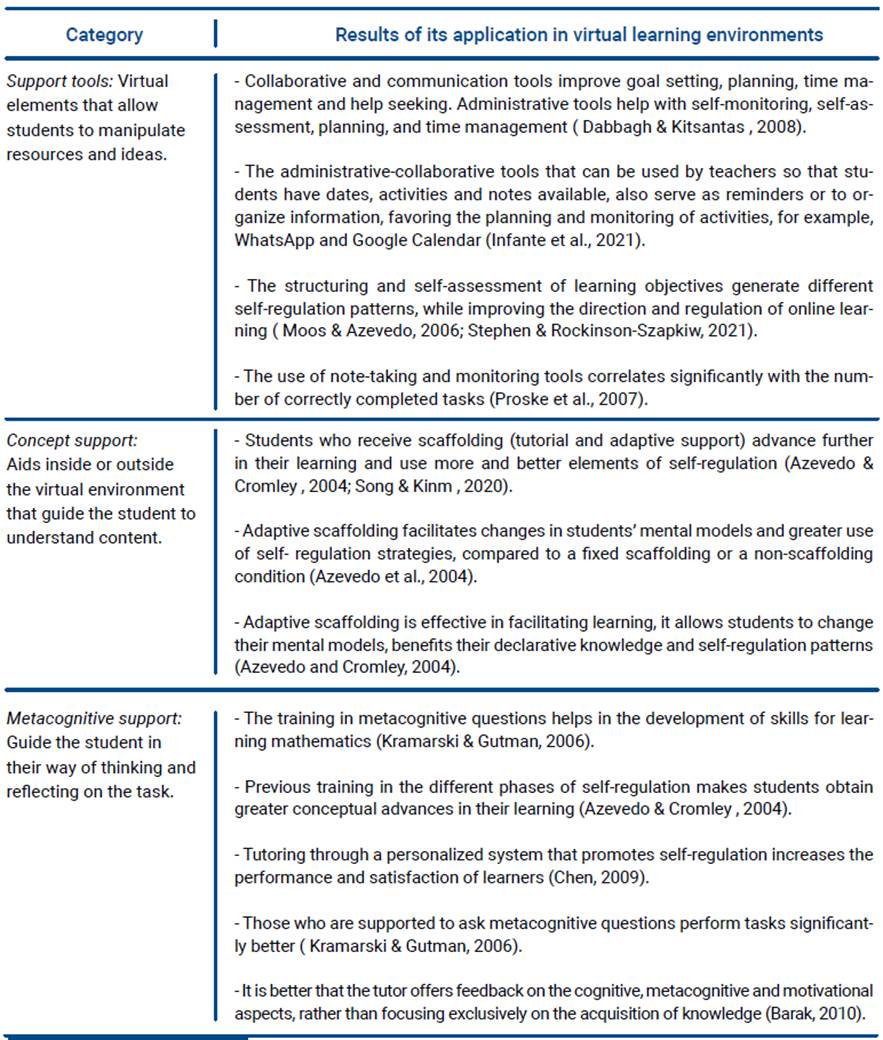
Following the classification proposed by Winters et al. (2008), the supports or conditions offered by virtual environments and that facilitate the improvement of the quality of students’ self-regulation can be divided into three general categories: a) tools within the virtual environment that allow students to manipulate resources and ideas such as taking notes, highlighting text, creation and communication tools; b) conceptual supports inside or outside the virtual environment that guide the student to understand content, static or adaptive scaffolding for conceptual understanding, and c) metacognitive supports that guide the student in ways of thinking and reflecting on their task, for example , in training in signs or warnings for self-monitoring and reflection.
Based on this classification, and with the intention of providing greater clarity, Table 1 selects some concrete representative examples of successful experiences that have been investigated in learning through virtual environments, to increase or create academic self-regulation competence.
Source: Own elaboration (2021).
Table 1: Some uses of virtual tools to improve self-regulation and metacognition.
Educational conditions for the promotion of self-regulation
Based on the evidence that has just been presented and the review by Artino & Ioannou (2008), whose work is the result of an exhaustive reading of the literature on self-regulation studies applied to online learning between the years 1995 and 2007, they can identify some successful experiences that can serve as a basis for the instructional process based on self-regulation.
First. Those with more adaptive profiles are more successful in virtual learning. In this sense, in the planning of a virtual course it is important to evaluate the components of self-regulated learning of students, for this, questionnaires can be used, offering individualized feedback. The results of the questionnaires can also be used by the virtual tutor to send reflective messages to students to promote their self-monitoring, as well as to create tasks and rubrics to support goal setting and self-assessment.
Second. According to the evidence, the motivational beliefs of the students are relevant within the pedagogical process (self-efficacy, intrinsic motivation and value of the task, among others). In this line, for example, the value of the task can be increased by discussing at the beginning of an activity the importance of this, designing online activities that are based on authentic problems, reflecting with the students on what type of specific learning tasks can contribute to the realization of their personal goals, interests and values, or using dynamic and synchronous systems (mobile devices and social networks, for example).
Third. Despite the widespread use of online discussion forums, it has been found that students rarely use their critical thinking skills during these discussions, opting instead for a rather superficial treatment of topics. Providing appropriate scaffolding for online discussions can increase the use of metacognitive tools. In this sense, the tutor can, through explicit comments and clarification of the argumentative criteria, model and exemplify appropriate discussions that focus on the specific topics and concepts of debate. Luis et al. (2006) report an activity in which students could freely express their ideas in a reflective manner in combination with peer feedback and support. In this activity, a group of first-year software engineering students was asked to write a reflective blog in response to questions from the tutor and other students. Blogs, therefore, were used to share knowledge and as a space for work and information.
Quarter. Students who seek help from others and collaborate with others have been shown to be more successful in virtual environments. Consistent with this finding, it is important to encourage collaboration and co-regulation, for example, by using peers as models for appropriate discussions, explicitly acknowledging well-written student comments, offering model assignment examples from outstanding students, or use group projects that encourage students to work together toward the same goal. English & Duncan (2008) promoted the use of Facebook in a group of student teachers during their teaching practice, to facilitate the sharing of stories and anecdotes. Results indicate that self-direction of their own learning was promoted as practitioners created, shared, and commented on each other’s contributions, allowing various forms of peer support to be created.
Specifically, in virtual blended learning environments, the literature indicates that some characteristics can be taken into account, since they favor the development of self-regulation skills by students, among them: authenticity, personalization, learning control, scaffolding, interaction and signals for reflection (Van & Elen, 2016).
Other thematic nodes related to online learning
Both self-regulation and metacognition are central issues in the educational context, which is why they have been addressed in research on other major topics of interest in virtual learning and teaching. In this section we will examine the links between the two topics that have been examined and other research topics that are supporting the expansion of knowledge in the area.
epistemic beliefs. According to Winters et al. (2008) and Martinez et al. (2009), in virtual training it is necessary to analyze epistemic beliefs due to their implication in motivation, learning and self-regulation. The learning that occurs with the intervention of self-regulation strategies is not limited to information or a specific domain, but must be reflected in the skills for learning. Virtual learning can facilitate the elaboration of a personal epistemology by making the search for information, decision-making and communication more reflective, probably as a consequence of the monitoring and metacognitive evaluation that these environments imply (Muis, 2007).
In the use of the Internet, Braten & Stromso (2009) and Stromso and Braten (2010) found that people with favorable epistemic beliefs towards the usefulness of this tool as a source of knowledge, towards seeking help and about self-regulation in learning (specifically in planning, monitoring and regulation), obtain better results, while those who tend to believe that computer-based learning requires less planning and organization, show greater difficulties in adapting to these learning environments.
Teaching metacognitive skills.DeStefano & Lefevre (2007) found that the interactivity of virtual learning, specifically in hypertexts, does not necessarily improve learning, especially in the case of students with low skills, while the structuring of the material did improve results. Thus, metacognitive strategies that promote reflection and ordering of the material, such as metacognitive questionnaires prior to the task, anticipation exercises and results planning, favor learning (Núñez et al., 2011). Some examples of metacognitive questions are: Do you think you know the topic? Are you clear about the meaning of…? Think about how you can relate the information to…? Do you reflect on what steps you should follow…? Think about what kind of difficulties you have to…? Think about how you can solve them? Reflect on what you are systematic? Think about how much interest you have in the task?
Tesouro (2004) offers an example of how metacognition can be fostered through assessment in virtual environments. In this approach, assessment is an integral part of the instructional process and fosters cognitive and metacognitive processes. He suggests starting by activating students’ previous learning, referring to examples of previous activities. Likewise, to activate students’ metacognition, it is recommended to make a reflexive correction of the possible interpretation errors of the developed exercise. On the other hand, to promote metacognitive capacity, it is important to self-assess, co-assess and discuss the questions of the exams after their qualification, as a complementary cognitive feedback to the grade obtained.
Problem Based Learning (PBL). Research with experiences in promoting self-regulation in face-to-face environments shows the usefulness of explicit discussion of learning objectives, the nature of the task and the problem-solving strategies used with students (Barak, 2010). Precisely, starting from problem situations is a strategy that implies the activation of processes of metacognition, planning, control and metacognitive evaluation. The so-called Problem-Based Learning (PBL) strategy has been used in both face-to-face and virtual environments. From this route, the active participation of students is promoted in each of the phases of the learning process, including the definition of problems, objectives, content, forms of evaluation and, in general, of the entire process. knowledge construction process.
Another way of approaching virtual learning through strategies that involve problem solving are research tasks such as those involved in webquests and similar strategies. For example, Quaresma & Oliveira (2009) included a webquest as an activity in an educational informatics course, emphasizing planning and monitoring, as well as the evaluation of process difficulties, which contributed to the understanding of the subject.
Self-monitoring and planning. Through monitoring, the learner compares the learning products with the criteria or standards to determine if in that phase of learning a task, the objectives have been achieved, or if more work is necessary to achieve them. Studies by Azevedo and Witherspoon (2009), specifically in virtual environments, point out that there are at least eight types of monitoring that students display and that if all or some of them are supported during the learning process, execution and comprehension of students improves significantly. They are presented below:
-
Sense of knowledge: the student realizes whether or not he has any previous familiarity with the material.
-
Judgment of learning: the learner realizes whether or not he is understanding what he is reading.
-
Use of strategies: in which the student realizes if the strategy he is using is useful or not for learning.
-
Self-test: the student asks himself some question to determine if he is understanding and determines if he should readjust his learning process.
-
Towards the goal: the student assesses whether he has managed to advance by completing the previous stages of learning.
-
Time monitoring: the student is aware of the time he has dedicated to the learning task.
-
Content evaluation: the student monitors the appropriateness or inappropriateness of the content being studied at that moment, taking into account the general vision of the pre-existing goals and sub-goals.
-
Adequate content expectation: it is similar to the previously described content evaluation, but in this case the students evaluate a content that they have not yet reached, generating expectations about what they will find.
Collaborative Learning. Some of the most used virtual activities are forums, debates or chats to promote collaborative learning. The proper use of these virtual spaces can favor metacognition and motivation and , with it, self-regulation skills. In a virtual learning environment the feeling of community is important. Fisher & Baird (2005) investigated the social aspects of an online course that support student self-regulation and retention. Among the social technologies used in this study was the platform itself (in this case Tapped In), the Newsgroups, the Web log (Blog), the chat and the Wiki. Some of the projects and activities used in the courses required students to develop collaboration and relationship skills crucial to passing the course. These projects offered a combination of personal and group skills, whereby the individual project was supported by the activities of the group projects.
Following this methodology, the researchers found that the elements that motivated students’ self-regulation were: the projects, since they are based on their intrinsic needs; the relevance of the projects and readings, due to the need to alleviate knowledge deficits; offer opportunities for autonomy and creativity; the use of social networks and collaborative tools on the Web; and peer support and feedback.
Seven practical guidelines to start implementing self-regulation in online learning
The results of the systematic review carried out by Rodrigues et al. (2019) on the literature published between 2010 and 2018 regarding online learning, indicate that educational innovation is one of the most recurrent contents in this area of knowledge. The implementation of innovation in online learning shows that it is a dynamic area of knowledge in which there is a growing interest in finding new strategies for students to learn under the different modalities offered by virtual learning environments.
Taking into account the aforementioned review of research in the area and Pintrich’s model (2000) on the components of self-regulated learning, a roadmap of seven practical considerations or guidelines to follow in order to promote self-regulated learning is proposed below. self-regulation and the improvement of virtual learning and teaching environments. These seven guidelines can be partially or totally taken into account in the design or improvement of virtual courses according to availability and available resources.
Guideline 1: Initial assessment of students’ self-regulatory skills and epistemic beliefs. This can be done through surveys, questionnaires or polls that should be made known to students through individualized and assertive feedback that increases their awareness of these topics, at the same time that they are referred to resources on the Web or to readings about what is the academic self-regulation and the erroneous beliefs that many students tend to have about the learning process in virtual environments.
The rule would be that the evaluation of the initial learning conditions allows the tutor to improve his orientation and helps the students to gain awareness and ownership of their pedagogical process.
Guideline 2: Promotion of planning. Promoting in students the setting of goals and sub-goals through a clear initial definition of the task, generates greater skills for learning. In the cognitive area, planning occurs through the establishment of specific objectives, the activation of previous knowledge, the recognition of the difficulty of the different tasks, the identification of the knowledge and skills necessary to face them or the knowledge about the sources and strategies that may be useful in the treatment of the task, among others. In the motivational area, it is useful to activate motivational beliefs (including self-efficacy, goals and value assigned to the task) and emotions. In the behavioral area, the planning of time and effort to be used in the tasks result in gains in the task. Finally, in the contextual area, the activation of perceptions about the task and its environment support learning (Pintrich, 2000).
To generate this movement of students towards planning, the virtual course designer or tutor can take advantage of the multiple forms of communication in virtual learning environments (for example, through forums, blogs, emails, calendars and activity logs) and can help establish initial clarity in the student regarding learning goals. students’ prior knowledge .
Guideline 3: Promotion of self-monitoring. As previously presented, in this phase the student monitors and pays attention to the behaviors he/she performs to solve the activity, while supervising his/her own results. Self-monitoring can be encouraged in students, for example, by means of the following reflective questions in the different phases of their learning process: a) Do I know something about the subject? b) Do I understand or not what I am reading?; c) Is my strategy useful to learn this content?; d) Am I making progress in my learning? e) How much time have I dedicated to the task? f) Am I achieving the goals and sub-goals outlined? and g) How do I see the content that I have not studied based on what I have previously advanced?
The rule would be to constantly encourage students to actively review their own learning process throughout the course.
Guideline 4: Promotion of self-control. The student, based on monitoring, tries to control his cognitions, behaviors or his learning environment to improve his performance. For example, the student may be aware that the level of comprehension of the reading he is doing is low and, therefore, he must implement remedial strategies such as repeating aloud, rereading or making a graph or a graph. conceptual representation. On the other hand, at a motivational level, the student may be aware of their ability to tackle a task and its importance or their behavior, seeking help or making more effort to understand the reading. Finally, it is important that the online student takes into account corrective measures that help the assimilation and retention of knowledge, such as taking notes online or on paper and making graphs or summaries , restricting the possibilities of copying and pasting.
The rule would be to lead students’ self- monitoring to include cognitive, behavioral, motivational and/or contextual corrections that improve their learning.
Guideline 5: Promotion of self-assessment.Pintrich (2000 describes the evaluation or reflection phase that includes judgments, attributions and general self-evaluations (at the motivational, behavioral and contextual level) that the student makes about their results and execution. For example, at the behavioral level a student may reflexively consider that he or she did not use the time appropriately to achieve a learning goal.
Formative assessment is a key part of the success of virtual learning environments, understanding that the most complete and impressive for the student is that this assessment is based on its three modalities: hetero-assessment, self-assessment and co-assessment.
The rule would be that a course should not be completed without the student making a conscious reflection on its process and on the cognitive, behavioral, motivational and/or contextual results.
Guideline 6: Promotion of motivation. For the success of the online learner, maintaining motivation towards learning activities becomes essential. To do this, tutors are recommended to use collaborative learning and seek help from peers, in order to create a sense of community, support and feedback that peers can offer through social networks and forums that generate an environment of regulation and collaboration.
For the increase of intrinsic motivation, it is recommended to increase the value of homework through the use of projects and relevant readings, the use of authentic problems of real life, the relationship of the projects or topics of the course with the personal goals of the student. student or with its relevance in the professional future. To maintain motivation, the use of a sense of humor, periodic questions that activate judgments and feelings, and integration with prior knowledge are suggested. At the design level, for the maintenance of motivation, the use of simulations and sound and image resources that maintain the interest of students by exploiting the different forms of information representation that virtual environments allow is recommended.
The rule would be that the motivation of the students should not be taken for granted: it should be generated and maintained throughout the course.
Guideline 7: Promotion of metacognition. The most complete strategy for increasing metacognition is Problem-Based Learning (PBL), since it activates problem-solving strategies in the student, generates opportunities to activate planning, self-monitoring, creativity and appropriation of knowledge. For these reasons, its use is recommended whenever possible in the design of virtual learning courses.
The rule would be that active learning strategies, such as PBL, are preferable to passive learning strategies.
Conclusions
To conceive of online learning as an extension of traditional/face-to-face learning would be a mistake. Although the pedagogical models derived from the educational sciences can be useful to improve the quality of any learning environment, online education presents some singularities that must be studied in a particular way.
Virtual learning environments involve a complex set of interactions of cognitive, metacognitive, motivational and affective processes in learners (Azevedo and Witherspoon, 2009). Currently, the social cognitive model of self-regulated learning provides important evidence and explanations about the interrelation between students’ metacognitive processes (awareness of their own knowledge and self-regulation of their own thinking) and their motivational beliefs (such as the intrinsic value of task, success expectations, self-assessment, and self-efficacy) (Pintrich, 2000; Zimmerman & Moylan , 2009).
From the evidence presented, it is clear that virtual environments, regardless of the thematic content, can incorporate explicit or implicit training in self-regulation to favor the development of these skills (Azevedo et al., 2006). However, one of the most important current challenges in this area is to achieve a real incorporation of empirical findings and theoretical developments into virtual instructional designs, through the appropriation of these by teachers and tutors (Garrido et al., 2013).
Although there are highly refined personalized systems (such as tutors or automated virtual platforms) designed with the aim of increasing students’ self-regulation skills, the virtual tutor can be and continues to be the fundamental scaffolding available to the virtual student to improve their performance. ability to learn to learn. For this reason, the orientation of the virtual tutor in the choice of tasks, the evaluation and the follow-up of his course, based on the incorporation of the results of educational research on self-regulation, can make a difference in daily educational practice. In these circumstances, the tutor offers an adaptive scaffolding and is an external regulator that can be key to increasing the quality of virtual teaching.
Azevedo et al. (2008) compared the results of adolescent students who received external regulation (a human tutor who facilitated their self-regulated learning) versus students in a self-regulated condition (responsible for regulating their own learning) in the teaching of science topics. The students who received the help of the tutor present greater declarative knowledge, more complex mental models, activate their prior knowledge, are involved in more monitoring activities, use effective study strategies and know how to seek help when they need it; while students responsible for their own learning process without help, use ineffective strategies and make insufficient use of monitoring activities on their own learning.
The incorporation of pedagogical strategies that promote learning to learn among students should not necessarily be difficult and complex. Authors such as Muis (2007) and Muis & Franco (2009) indicate that self-regulation can be facilitated if a simple four-point guideline is followed: 1) define the task; 2) plan and define goals; 3) execute the strategy and 4) evaluate it.
Finally, it is useful to reflect on some of the challenges for the future of this area of study. First, the improvement of the quality of online courses. It would be convenient for the institutions that bet on virtual training to take into account the quality of the pedagogical training that they offer both to their tutors and to the designers of online courses.
The research results and the high levels of desertion of virtual learning lead us to think that tutors and designers of virtual courses should have a higher pedagogical training, even higher than the trainers who work in traditional learning environments.
Second, it is highly recommended that these improvements focus on strengthening the competence to learn to learn in the students who join this learning modality throughout the process, as a protective element against desertion.
Third, it is necessary to bring the advances in educational research closer to daily pedagogical practice, and this will only be achieved from the recognition of the particular demands presented by virtual learning environments.
Fourth, research on the self-regulation of learning must take into account both the process and the product of learning, so that there is increasingly more evidence on the micro-processes that students follow online during their educational interaction.
Se plantean las nuevas necesidades de la sociedad del aprendizaje continuo, que surgen a partir del uso de los entornos virtuales de aprendizaje antes y posteriores al COVID-19. Se realizó una revisión actualizada de la literatura y de algunas de las teorías sobre la metacognición y la autorregulación, para dar respuesta a los nuevos retos de los aprendices, tutores y diseñadores del aprendizaje en línea. Se discuten las ventajas que ofrece el fomento de la autorregulación en los aprendices en línea, y sobre sus competencias para aprender, y se ofrece una guía práctica para tutores. La evidencia señala que incorporar un entrenamiento explícito o implícito en autorregulación genera en los estudiantes un mejor rendimiento y calidad del aprendizaje. Se presentan siete pautas para mejorar la planificación, que van desde la evaluación preliminar de la capacidad de autorregulación del estudiante hasta el fomento de la metacognición, el automonitoreo y la motivación.
The new needs of the continuous learning society, arising from the use of virtual learning environments before and after COVID-19, are discussed. An updated review of the literature and some of the theories on metacognition and self-regulation was carried out to respond to the new challenges of learners, tutors and designers of online learning. The advantages of fostering self-regulation in online learners and their learning competencies are discussed, and a practical guide for tutors is offered. Evidence indicates that incorporating explicit or implicit training in self-regulation generates better performance and quality of learning in students. Seven guidelines for improving planning are presented, ranging from preliminary assessment of the student’s self-regulation skills to fostering metacognition, self-monitoring, and motivation.




References
Alonso-García, S., Aznar-Díaz, I., Cáceres-Reche, M., Trujillo-Torres, J. & Romero-Rodríguez, J. (2019). Systematic review of good teaching practices with ICT in Spanish Higher Education. Trends and Challenges for Sustainability. Sustainability, 11(24), 7150.
Artino, A. & Ioannou, A. (2008). Promoting Academic Motivation and Self-Regulation: Practical Guidelines for Online Instructors. In K. McFerrin et al. (Eds.), Proceedings of Society for Information Technology & Teacher Education International Conference 2008 (pp. 208-212). AACE.
Azevedo, R. (2020). Reflections on the field of metacognition: Issues, challenges, and opportunities. Metacognition and Learning, 15, 91-98.
Azevedo, R. & Cromley, J. (2004). Does training on self-regulated learning facilitate students’ learning with hypermedia? Journal of Educational Psychology, 96(3), 523-535.
Azevedo, R., Cromley, J. & Seibert, D. (2004). Does adaptive scaffolding facilitate students’ ability to regulate their learning with hypermedia? Contemporary Educational Psychology, 29(3), 334-370.
Azevedo, R., Cromley, J., Winters, F., Moos, D. & Greene, J. (2006). Using Computers as MetaCognitive Tools to Foster Students’ Self-Regulated Learning. Technology, Instruction, Cognition and Learning Journal, 3(1), 97-104.
Azevedo, R., Moos, D., Greene, J., Winters, F. & Cromley, J. (2008). Why is externally-facilitated regulated learning more effective than self-regulated learning with hypermedia? Education Tech Research Dev, 56(3), 45–72.
Azevedo, R. & Witherspoon, A. (2009). Self-regulated use of hypermedia. En Handbook of metacognition in education (pp. 219-239). Erlbaum.
Banihashem, S., Farrokhnia, M., Badali, M. & Noroozi, O. (2021). The impacts of constructivist learning design and learning analytics on students’ engagement and self-regulation. Innovations in Education and Teaching International, 1-11.
Barak, M. (2010). Motivating self-regulated learning in technology education. Int J Technol Des Educ, 20(3), 381-401.
Barbera, E. (2004). La educación en red. Actividades virtuales de enseñanza y aprendizaje. Paidós.
Barbour, M. & Reeves, Th. (2009). The reality of virtual schools: A review of the literature. Computers & Education, 52(2), 402–416.
Bernal, F., Guzmán, N. & Andrade, J. (2020). Virtual Learning and Training Needs in a Peripheral Region of Colombia. TEM Journal, 9(4), 1681. https://doi.org/10.18421/TEM94-47
Bernard, R., Abrami, Ph., Lou, Y., Borokhovski, E., Wade, A., Wozney, L., Wallet, P. & Fiset, M. (2004). How Does Distance Education Compare with Classroom Instruction? A Meta-analysis of Empirical Literature. Review of Educational Research, 74(3), 379-439.
Booker, E. & Rebman, C. (2005). E-student retention: Factors affecting customer loyalty for online program success. Issues in Information Systems, 6(1), 183-189.
Boring, E. (1999). Historia De La Psicología Experimental. Ed. Trillas.
Braten, I. & Stromso, H. (2009). Effects of Task Instruction and Personal Epistemology on the Understanding of Multiple Texts About Climate Change. Discourse processes, 47(1), 1-31.
Brown, A. (1987). Metacognition, executive control, self-regulation, and other more mysterious mechanisms. En Metacognition, motivation, and understanding (pp. 65-116). Erlbaum.
Chen, C. (2009) Personalized E-learning system with self-regulated learning assisted mechanisms for promoting learning performance. Expert systems with applications, 36(5), 8816-8829.
Coll, C. (2008). Aprender y enseñar con las TIC: expectativas, realidad y potencialidades. Boletín de la Institución Libre de Enseñanza, 72(1), 17-40.
Coussement, K., Phan, M., De Caigny, A., Benoit, D. & Raes, A. (2020). Predicting student dropout in subscription-based online learning environments: The beneficial impact of the logit leaf model. Decision Support Systems, 135, 113325.
Dabbagh, N. & Kitsantas, A. (2004). Supporting self-regulation in student centered Web based learning environments. International Journal on E-learning, 3(1), 40-47.
De la Fuente, J., Peralta-Sánchez, F., Martínez-Vicente, J., Sander, P., Garzón-Umerenkova, A. & Zapata, L. (2020). Effects of Self-Regulation vs. External Regulation on the Factors and Symptoms of Academic Stress in Undergraduate Students. Front. Psychol, 1773. https://doi.org/10.3389/fpsyg.2020.01773
De la Fuente, J., Sander, P., Garzón-Umerenkova, A., Vera-Martínez, M., Fadda, S. & Gaetha, M. (2021). Self-Regulation and Regulatory Teaching as Determinants of Academic Behavioral Confidence and Procrastination in Undergraduate Students. Frontiers in Psychology, 12.
DeStefano, D. & LeFevre, J. (2007). Cognitive load in hypertext reading: A review. Computers in human behavior, 23(3), 1616-1641.
Díaz, F. & Hernández, G. (2010). Estrategias docentes para un aprendizaje significativo: una interpretación constructivista. McGraw Hill.
Dillon, A. & Jobst, J. (2005). Multimedia learning with hypermedia. En The Cambridge handbook of multimedia learning (pp. 569-588). Cambridge University Press.
English, R. & Duncan, J. (2008). Facebook goes to college: Using social networking tools to support students undertaking teaching practicum. Journal of Online Learning and Teaching, 4(4), 596-601.
Fermín-González, M. (2019). Research on virtual education, inclusion, and diversity: A systematic review of scientific publications (2007– 2017). International Review of Research in Open and Distributed Learning, 20(5), 146-167.
Fisher, M. & Baird, D. (2005). Online learning design that fosters student support, self-regulation, and retention. Campus - Wide Information Systems, 22(2), 88-107.
Flavell, J. (1985). El desarrollo cognitive. Visor.
Frankola, K. (2001). Why Online Learners Drop Out: High dropout rates are e-learning’s embarrassing secret. Here’s what you can do about it. Business Library. http://findarticles.com/p/articles/mi_m0FXS/is_10_80/ai_79352432/
Garrido, J., Contreras, D. & Miranda, C. (2013). Análisis de la disposición pedagógica de los futuros profesores para usar las TIC. Estudios Pedagógicos, 39(Especial), 59-74.
Garzón, A. & Gil, J. (2017). El papel de la procrastinación académica como factor de la deserción universitaria. Revista Complutense de Educación, 28(1), 307-324. https://doi.org/10.5209/revRCED.2017.v28.n1.49682
Garzón, A., De la Fuente, J., Amate, J., Paoloni, P., Fadda, S. & Pérez, J. (2018). A Linear Empirical Model of Self-Regulation on Flourishing, Health, Procrastination, and Achievement, Among University Students. Frontiers in psychology, 9, 536.
Heller, N. (2020). Pervasive learning analytics for fostering learners’ self-regulation [doctoral disertation, Universität München] ludwig maximilian university of munich]. Elektronische Hochschulschriften der LMU München. https://edoc.ub.uni-muenchen.de/26428/
Henao, O. (2002). La enseñanza virtual en la educación superior. ICFES.
Hernández, F. & Rodríguez, C. (2002). Alternativa de un modelo virtual para mejorar la enseñanza de inglés. Fondo de Publicaciones Universidad Distrital Francisco José de Caldas.
Infante, V., Dapelo, B., Cobo, R., López, Y., Escobar, B. & Beyle, C. (2021). Aplicaciones que emplean y recomendaciones que entregan docentes universitarios para la autorregulación del aprendizaje en contexto de la pandemia por COVID-19. Texto Livre, 14(3), 1-24.
JISC. (2007). Effective Practice with e-Assessment. An overview of technologies, policies and practice in further and higher education. Higher Education Funding Council for England (HEFCE) on behalf of JISC.
JISC. (2010). Effective Assessment in a Digital Age. A guide to technology-enhanced assessment and feedback. Higher Education Funding Council for England (HEFCE) on behalf of JISC.
Kramarski, B. & Gutman, M. (2006). How can self-regulated learning be supported in mathematical E-learning environments? Journal of Computer Assisted Learning, 22(1), 24–33.
Lai, C. & Hwang, G. (2021). Strategies for enhancing self-regulation in e-learning: a review of selected journal publications from 2010 to 2020. Interactive Learning Environments, 1-23.
Laskey, M. & Hetzel C. (2010). Self-regulated Learning, Metacognition, and Soft Skills: The 21St Century Learner. Online submition. http://20.132.48.254/ERICWebPortal/search/recordDetails.jsp?ERICExtSearch_Descriptor=%22Generation+Gap%22&_pageLabel=RecordDetails&accno=ED511589&_nfls=false
Lee, D., Watson, S. & Watson, W. (2019). Systematic literature review on self-regulated learning in massive open online courses. Australasian Journal of Educational Technology, 35(1).
Lovos, E., & Aballay, L. (2020). Deserción Académica y Emociones en Ambientes E-learning. Revista Iberoamericana de Tecnología en Educación y Educación en Tecnología, (27), 89-94.
Lui, A., Choy, S., Cheung, Y. & Li, S. (2006). A study on the perception of students towards educational weblogs. Informatics in Education, 5(2), 233-254.
Martínez, R., Montero, Y. & Pedrosa, M. (2009). Una aproximación a las creencias epistemológicas y pedagógicas de los profesores y a su valoración de internet. Revista Iberoamericana de Educación, 51(1), 1-15.
Moos, D. & Azevedo, R. (2006). The role of goal structure in undergraduates’ use of self-regulatory variables in two hypermedia learning tasks. Journal of Educational Multimedia and Hypermedia, 15(1), 49–86.
Muis, K. (2007). The Role of Epistemic Beliefs in Self-Regulated Learning. Educational psychologist, 42(3), 173-190.
Muis, K. & Franco, G. (2009). Epistemic beliefs: Setting the standards for self-regulated learning. Contemporary educational psychology, 34(4), 306-318.
Núñez, C., Cerezo, R., González-Pienda, J., Rosário, P., Valle, A., Fernández, E. & Suárez, N. (2011). Implementation of training programs in self-regulated learning strategies in Moodle format: Results of a experience in higher education. Psicothema, 23(2), 274-281.
Organista, P. (2005). Conciencia y metacognición. Avances en psicología latinoamericana, 23(1), 77-89.
Palalas, A. & Wark, N. (2020). The relationship between mobile learning and self-regulated learning: A systematic review. Australasian Journal of Educational Technology, 36(4), 151-172.
Piaget, J. (1970). La toma de conciencia. Planeta.
Piaget, J. (1980). Problemas de psicología genética. Planeta.
Pintrich, P. (2000). The role of goal orientation in self-regulated learning. En Handbook of self-regulation (pp. 452–502). Academic Press.
Porter, M. (1991). La ventaja competitiva de las naciones. Vergara.
Pozo, J. & Monereo, C. (1999). El aprendizaje estratégico. Alianza.
Proske, A., Narciss, S. & Körndle, H. (2007). Interactivity and Learners’ Achievement in Web-Based Learning. Journal of Interactive Learning Research, 18(4), 511-531.
Quaresma, F. & Oliveira, H. (2009). A webquest como atividade didática potencilizadora da educação. RENOTE, 7(1). http://es.scribd.com/doc/93425899/A-webquest-como-atividade-didatica
Rodríguez, M. (2009). Motivar para aprender en situaciones académicas. En La crisis de la escuela educadora (pp. 207-242). Laertes.
Rodrigues, H., Almeida, F., Figueiredo, V. & Lopes, S. (2019). Tracking e-learning through published papers: A systematic review. Computers & Education, 136, 87-89.
Sanhueza, J. (2006). Características de las prácticas pedagógicas con TIC y efectividad escolar. Revista Digital de Educación y Nuevas Tecnologías, 36(3), 1-8. http://contexto-educativo.com.ar/2005/3/nota-09.htm
Schunk, D. & Zimmerman, B. (1989). Self-regulation of Learning and Performance: Issues and Educational Applications. Lawrence Erlbaum Associates.
Serrano, J. & Pons, R. (2011). El constructivismo hoy: enfoques constructivistas en educación. Revista Electrónica de Investigación Educativa, 13(1), 1-27.
Song, D. & Kim, D. (2020). Effects of self-regulation scaffolding on online participation and learning outcomes. Journal of Research on Technology in Education, 53(3), 149-263.
Stephen, J. & Rockinson-Szapkiw, A. (2021). A high-impact practice for online students: the use of a first-semester seminar course to promote self-regulation, self-direction, online learning self-efficacy. Smart Learning Environments, 8(1), 1-18.
Stromso, H. & Braten, I. (2010). The role of personal epistemology in the self-regulation of internet-based learning. Metacognition Learning, 5(1), 91-111.
Teräs, M., Teräs, H., Arinto, P., Brunton, J., Daryono, D. & Subramaniam, T. (2020) COVID-19 and the push to online learning: reflections from 5 countries. Digital Culture and Education. URL: https://www.digitalcultureandeducation.com/reflections-on-covid19/reflections-from-5-countries#
Tesouro, M. (2004). Innovemos la evaluación utilizándola como instrumento metacognitivo. Aula de Innovación Educativa, (137), 62-64.
Van, S. & Elen, J. (2016). In search of attributes that support self-regulation in blended learning environments. Education and Information Technologies, 22(4), 1395-1454.
Vygotski, L. (1987). Pensamiento y lenguaje. La Pléyade.
Vygotski, L. (1989). El desarrollo de los procesos psíquicos superiores. Crítica.
Winters, F., Greene, J. & Costish, C. (2008). Self-Regulation of Learning within Computer based Learning Environments: A Critical Analysis. Educ Psychol Rev, 20(4), 429-444.
Wong, J., Baars, M., Davis, D., Van Der Zee, T., Houben, G. & Paas, F. (2019). Supporting self-regulated learning in online learning environments and MOOCs: A systematic review. International Journal of Human–Computer Interaction, 35(4-5), 356-373. https://doi.org/10.1080/10447318.2018.1543084
Wood, D., Bruner, J. & Ross, G. (1976). The role of tutoring in problem solving. J. Child Psychol. Psychiat., 17(2), 89-100.
Yang, Y. & Cornelius, L. (2004). Students’ Perceptions towards the Quality of Online Education: A Qualitative Approach. Association for Educational Communications and Technology, 27th. http://eric.ed.gov/?id=ED485012.
Zimmerman, B. (1996). Enhancing Student Academic and Health Functioning: A SelfRegulatory Perspective. School Psychology Quarterly, 11(1), 47-66.
Zimmerman B. & Moylan, A. (2009). Where metacognition and motivation intersect. En Handbook of metacognition in education (pp. 299-315). Erlbaum.

This work is licensed under a Creative Commons Attribution-NonCommercial-ShareAlike 4.0 International License.
The authors transfer the patrimonial rights of their article to the Escuela Superior de Administración Pública - ESAP, while retaining the moral rights to their works. Articles in the journal Administración & Desarrollo are subject to the Creative Commons Attribution-Noncommercial-ShareAlike Attribution License that allows third parties to copy, reproduce, distribute, publicly communicate the work, and create derivative works, provided that the original author is cited and acknowledged, the first publication in this journal is indicated, the work is not used for commercial purposes, and the distribution of derivative works is done under a license of the same type.
The CC BY-NC-ND license was previously used, but it was changed to CC BY-NC-SA.